Specifying the wrong fan for an automotive application doesn't just mean a performance miss -- it means premature failures, EMC rejection, and costly recalls. Automotive cooling demands a fundamentally different product.
DC blower fans for automotive applications must survive temperature extremes from −40 °C cold starts to sustained 85 °C+ under-hood operation, continuous vibration, and dense electromagnetic interference -- while meeting regulatory compliance standards that standard industrial or consumer blower products were simply never designed to address.
- Automotive cooling is a fundamentally more demanding design environment than industrial or consumer electronics cooling, and standard blower products routinely fail its combined thermal, mechanical, and electrical stress requirements.
- Temperature cycling from deep cold to sustained high heat is a primary failure driver, attacking motor windings, bearing lubricants, and blade materials simultaneously.
- Vibration and shock loads from road use and engine mounting impose structural requirements far beyond those of stationary equipment, demanding purpose-built housing and motor designs.
- EMC compliance in an automotive electrical environment is non-negotiable for certification and customer acceptance, yet it's one of the most commonly underestimated challenges at the sourcing stage.
- Sourcing automotive-grade blowers requires tracing the supplier's actual qualification process -- datasheet claims alone are insufficient, and IATF 16949 certification at the manufacturing level is the practical minimum credibility threshold.
Understanding exactly where standard blowers fall short -- and why -- is the only reliable way to specify a DC blower that actually survives automotive service.
Table of Contents
Why Is Automotive Cooling a Fundamentally Different Design Problem?
Standard industrial cooling specs are not a conservative starting point for automotive work -- they're a different spec category entirely.
Automotive cooling systems combine ambient temperature extremes, persistent vibration, voltage transients, EMC regulatory requirements, and qualification process rigor into a single package that standard blower products were not engineered to address -- any one of these factors alone can cause a standard product to fail, and in automotive service they all arrive simultaneously.
What Makes the Automotive Environment Uniquely Hostile
A DC blower running in a server rack faces a relatively controlled environment: stable ambient temperature, clean regulated power, no mechanical shock, and a qualification process that generally accepts published datasheet specs. An automotive blower faces none of those conditions. Ambient temperatures swing from deep-freeze cold soak to sustained high-temperature operation under hood or behind a dashboard. Electrical supply voltage fluctuates across transients that can momentarily far exceed nominal, and the EMC environment is dense with switching noise from inverters, solenoids, and motor drives throughout the vehicle.
The qualification bar is also qualitatively higher. Automotive OEMs and Tier 1 suppliers specify test protocols and documentation requirements -- covering FMEA, PPAP, and ongoing production validation -- that go well beyond what a standard industrial component supplier typically supports. This means a blower that is technically adequate in isolation may still be rejected at program qualification if the supplier cannot provide the required documentation and lot-level testing traceability.
What Do Temperature Extremes and Thermal Cycling Actually Do to a Blower Fan?
Temperature extremes don't just stress a blower at the limits -- the cycling between them is where most real failures originate.
Repeated cycling between −40 °C cold soak and sustained high-temperature operation attacks motor windings, bearing lubricants, and blade materials through thermal expansion mismatch and repeated mechanical stress accumulation -- standard fans are not designed with this fatigue mechanism in mind, and failures typically emerge after hundreds of cycles, not immediately.
How Thermal Cycling Fails Each Component Differently
Motor windings fail through gradual insulation degradation as materials repeatedly expand and contract across a wide temperature range, eventually cracking insulation at solder joints and winding edges where stress concentrates. Bearing lubricants present a separate failure path: standard greases and oils have viscosity-temperature profiles designed for narrower operating bands, and at −40 °C the lubricant can become too viscous to flow properly on startup, causing dry-contact wear during the first seconds of each cold start. At sustained high temperatures, the same lubricant may thin beyond its designed operating range, reducing film thickness and accelerating wear.
Blade and housing materials undergo dimensional change at both extremes, and the mismatch between blade, housing, and motor mounting materials -- if dissimilar materials with different thermal expansion coefficients are used -- generates mechanical stress at every cycle. Over thousands of cycles, this produces fatigue at mounting points and blade roots that eventually leads to cracking or loose assembly.
Automotive-grade blower designs address this through lubricant selection validated across the full operating temperature range, winding materials and insulation grades chosen for thermal cycling durability, and housing geometry that accommodates dimensional change without transferring stress to critical joints. Temperature cycling test systems -- which subject samples to programmed thermal profiles over hundreds or thousands of cycles -- are how this durability is validated rather than assumed.
How Do Vibration and Shock Requirements Change the Engineering?
Road-induced vibration and mechanical shock are continuous in-service stresses, not edge-case events.
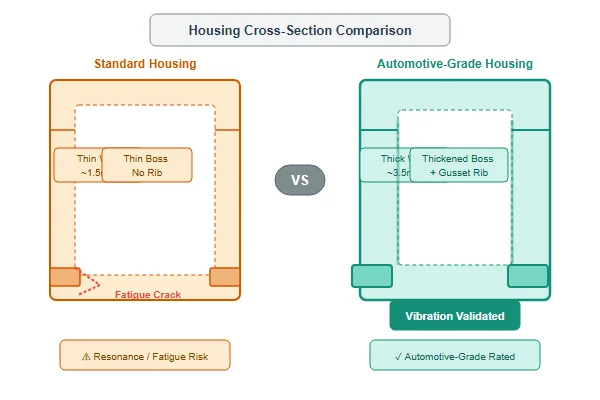
Vibration from road surfaces and engine mounts creates resonance risks and fatigue at mounting points, connector interfaces, and blade-motor joints that standard blowers are not designed to withstand long-term -- automotive-grade designs require purpose-built housing structures, motor retention geometry, and connector systems that hold tolerance under continuous dynamic load.
Why Stationary-Equipment Fan Designs Fail Under Road Vibration
A blower designed for stationary HVAC or electronics cooling assumes that vibration, if it occurs at all, is occasional and low-amplitude. Automotive service is the opposite: continuous broadband vibration from road surfaces combined with occasional higher-amplitude shocks from rough surfaces or impact events. The practical failure modes this introduces include connector fretting -- where micro-motion at electrical connectors causes oxidation and intermittent contact -- fatigue cracking at housing mounting bosses, and progressive loosening of blade-motor joints that were press-fit or adhesively bonded rather than mechanically retained.
Resonance is a particular concern. If a blower assembly's natural frequency falls within the typical road vibration spectrum (roughly 10–200 Hz for most vehicle applications), normal road use can excite resonance and dramatically accelerate fatigue damage. Automotive-grade designs are typically validated through drop tests and vibration table testing across representative frequency sweeps to confirm that resonance peaks do not fall in service-relevant ranges, and that the assembly survives the required number of vibration hours without fatigue failure.
Why Is EMC Compliance So Hard to Achieve in an Automotive Electrical Environment?
The automotive electrical environment is one of the most electromagnetically noisy environments a DC motor product will ever operate in.
Automotive EMC compliance requires that a blower fan neither emits interference that degrades surrounding vehicle electronics nor succumbs to the conducted and radiated interference generated by inverters, solenoids, and motor drives throughout the vehicle -- standard blowers with no EMC-specific design measures routinely fail both requirements in an automotive context.
What EMC Compliance Actually Requires at the Component Level
Electromagnetic compatibility1 for automotive components is governed by standards such as CISPR 25 for radiated and conducted emissions and ISO 11452 for immunity testing. These set specific limits for both how much interference a component can emit into the vehicle's 12 V or 48 V bus and wiring harness, and how much interference it must tolerate without malfunction. A DC brushless blower motor with unfiltered PWM drive electronics and no EMI suppression circuitry will typically fail emissions limits even at modest motor power levels, because the switching frequencies and their harmonics fall directly in protected vehicle communication frequency bands.
Achieving compliance requires EMC-specific measures designed in from the start: proper motor driver filtering, appropriate bypass capacitors at the motor terminals, shielded wiring or filtered connectors where the harness runs near sensitive circuits, and physical layout decisions that minimize loop areas for high-frequency switching currents. These are not modifications that can be added to a standard blower after the fact -- they need to be part of the original motor and driver design. This is one of the clearest examples of why dropping a standard industrial blower into an automotive application is not a shortcut but a reliability and certification risk.
What Should You Actually Verify When Sourcing Automotive-Grade Blowers?
Sourcing automotive-grade blowers correctly requires verifying the supplier's actual qualification infrastructure, not just reading their datasheet claims.
Sourcing an automotive-grade DC blower fan requires confirming IATF 16949 certification at the manufacturing facility level, asking for specific test data across the relevant thermal and vibration profiles, and validating that the supplier's quality process supports automotive documentation requirements -- none of which can be inferred from a standard product datasheet.
Why Standard Procurement Criteria Are Insufficient
The single most common sourcing mistake at the industrial-to-automotive transition is treating a product described as "automotive-grade" on a datasheet as self-certifying. The term has no universal legal or regulatory definition -- a supplier can apply it to any product. The meaningful verification criteria are process-level: Does the facility hold IATF 169492 certification, which mandates automotive-specific quality management processes for automotive component manufacturing? Can the supplier provide actual test reports from temperature cycling, vibration, and EMC testing -- not just a claim that the product meets certain conditions? Does the supplier support PPAP submission and FMEA documentation for their automotive customers?
Beyond certification, it's worth asking specifically which test equipment is operated in-house versus which testing is contracted out to third parties. In-house temperature cycling, salt spray, and vibration testing capability is a meaningful differentiator because it affects the supplier's ability to turn around qualification data on a project timeline and to perform ongoing production lot validation rather than one-time qualification testing only.
| Verification Item | Why It Matters | Weak Answer | Strong Answer |
|---|---|---|---|
| IATF 16949 cert | Confirms automotive QMS process | "We follow automotive standards" | Certificate number, scope, issuing body |
| Temperature cycling data | Validates thermal fatigue durability | "Rated to −40 °C to 85 °C" | Test report: cycles, ramp rates, failure criteria |
| Vibration/shock test data | Validates mechanical durability | "Designed for automotive" | Actual test profile and hours/pass criteria |
| EMC test reports | Confirms emissions and immunity | "Low EMI design" | CISPR 25 or equivalent test report |
| PPAP support | Required for OEM/Tier 1 programs | "We can try" | PPAP submission history and APQP experience |
Our Dongguan facility carries IATF 16949 certification alongside ISO 9001, and our in-house test infrastructure includes a temperature cycling test system and salt spray test system specifically relevant to automotive qualification programs. When you're evaluating a DC high-speed vortex blower for an automotive cooling or HVAC application, we can provide actual test data from these systems -- not datasheet claims -- and discuss what qualification documentation the program requires.
What Failure Modes Show Up in the Field When the Wrong Blower Is Specified?
Field failures from wrong blower specifications follow predictable patterns -- recognizing them early saves significant rework cost.
The most common automotive blower field failures from underspecified products are bearing failure from thermal cycling and cold-start lube degradation, connector intermittency from vibration fretting, and EMC-induced communication errors in nearby vehicle electronics -- all of which typically appear after months of service rather than in initial validation testing.
Why These Failures Are Difficult to Catch Before Launch
Each of these failure modes shares a frustrating characteristic: they rarely appear during short-duration validation testing on new samples at room temperature, which is exactly the testing a standard industrial blower would pass. Bearing lubricant failure from cold-start cycling accumulates over hundreds of start cycles spanning months of real-world use. Connector fretting is a wear mechanism that takes sustained vibration exposure to progress to the point of causing intermittent contact. EMC failures often only manifest when multiple vehicle subsystems are operating simultaneously in a specific combination, creating interference conditions that bench testing at the component level may not replicate.
This latent failure character is precisely why automotive qualification protocols are structured around accelerated life testing with specific cycle counts and stress profiles -- the goal is to compress months or years of field exposure into a manageable test duration before launch, rather than discovering failure modes post-launch through warranty claims. Specifying a blower from a supplier whose qualification infrastructure cannot generate this kind of accelerated life data means accepting that the in-field population becomes the test population, which is an untenable risk position for any serious automotive program.
How Does Automotive Installation Geometry Affect Blower Selection and Integration?
Physical installation constraints in automotive enclosures are tight enough that blower geometry and mounting features need to be addressed at the specification stage, not during integration.
Automotive HVAC and electronics cooling enclosures impose strict volumetric constraints, specific mounting boss geometries, and harness routing requirements that can rule out standard off-the-shelf blower form factors entirely -- getting blower geometry and connector position specified correctly upfront prevents the costly design iterations that come from discovering fit issues during prototype builds.
Why Standard Form Factors Often Don't Fit Automotive Assemblies
Automotive assemblies are designed to precise packaging envelopes, often with every cubic centimeter allocated. Standard industrial blower form factors carry no obligation to match automotive enclosure mounting patterns, connector positions, or outlet duct interfaces -- they're designed to fit standard industrial cabinet cutouts and duct standards. This means that even a blower with correct thermal and EMC performance may require a custom housing variant, repositioned connector, or modified outlet geometry to actually fit the target assembly without interference.
The earlier in the design process these geometry constraints are communicated to the blower supplier, the more options are available. At early design stages, custom housing dimensions or connector relocation are relatively straightforward engineering changes. At late prototype or pre-production stages, the same changes carry tooling cost, schedule impact, and risk of introducing new qualification gaps that have to be tested all over again. Treating blower geometry specification with the same rigor as the electrical and thermal specifications -- rather than assuming a standard catalog item will fit -- is a common lesson learned the expensive way on automotive programs.
FAQ
What temperature range should an automotive DC blower fan be rated for?
Most automotive under-hood and cabin HVAC applications require a minimum operational range of −40 °C to 85 °C continuous, with some under-hood locations requiring brief survival to higher temperatures. Verify the specific thermal requirement for the mounting location in the vehicle rather than applying a single universal spec.
Does IATF 16949 certification apply to the product or the factory?
IATF 16949 is a quality management system certification applied to a manufacturing facility and its processes, not to individual products. A certified facility has documented automotive-specific quality processes in place, which is a necessary condition for reliable automotive supply but not by itself a product performance guarantee.
Can a high-quality industrial blower fan be used as a direct substitute in an automotive application to reduce cost?
Not reliably. Industrial blowers are not tested to automotive thermal cycling, vibration, or EMC profiles, and the qualification documentation they support does not meet automotive OEM or Tier 1 requirements. The cost difference between industrial and automotive-grade products is typically far smaller than the cost of a single field failure event or PPAP rejection.
What is PPAP, and do DC blower suppliers typically support it?
PPAP, the Production Part Approval Process, is a standardized set of documentation and sample submission requirements used by automotive OEMs and Tier 1 suppliers to qualify new components for production programs. Not all blower suppliers support it -- asking directly whether the supplier has PPAP submission experience and can provide the required documentation package is an important early qualification filter.
How does voltage transient resistance factor into automotive blower selection?
Automotive electrical systems generate load dump transients, reverse polarity events, and supply voltage swings that can exceed the absolute maximum ratings of motor driver ICs in standard blower designs. Automotive-grade motor drivers specify survival ratings for these transient conditions explicitly, while standard industrial drivers often do not -- this is a meaningful difference that belongs in the technical specification review.
Is salt spray testing relevant to all automotive blower applications?
Salt spray resistance matters primarily for blowers mounted in locations with exposure to road splash, wheel well environments, or exterior HVAC intakes where humid salty air is a realistic exposure. Internal cabin electronics cooling applications may have lower salt spray requirements, but confirming the expected exposure environment with the vehicle integrator before omitting this requirement is the safer approach.
Automotive cooling demands more from a DC blower than any standard industrial spec covers -- and the consequences of getting it wrong arrive as field failures, not bench failures. Herays has manufactured DC fans and blowers from our Dongguan facility for 20+ years, with IATF 16949, ISO 9001, ISO 14001, and QC 080000 certification and in-house thermal cycling and salt spray test systems to back automotive qualification programs. If your application has specific thermal, vibration, or EMC requirements, we're glad to work through the specification and documentation requirements together.
Electromagnetic compatibility is the ability of a device or system to operate within its electromagnetic environment without causing or suffering interference. In automotive applications it is a regulatory and functional requirement, not an optional design refinement, because interference with vehicle communication buses can cause safety-critical system malfunctions. ↩
IATF 16949 is a quality management system standard specific to automotive production and service part organizations, developed by the International Automotive Task Force. It mandates processes for FMEA, PPAP, and production part validation that go significantly beyond the requirements of general ISO 9001 certification, and is the practical minimum qualification standard for automotive component suppliers to OEMs and Tier 1 customers. ↩

Liang
I've been working with DC fans for 30 years — long enough to have seen the industry evolve from basic sleeve bearing designs to today's high-efficiency, IP68-rated systems built for the harshest environments imaginable. I founded Herays because I believed manufacturers and engineers deserved a supplier who could talk technical from day one. Not just hand over a datasheet, but actually help you select the right fan for your thermal load, your enclosure, your certification requirements. Most of what I write here comes directly from problems I've solved on the factory floor or in customer applications — medical devices, laser equipment, industrial automation, you name it. If it involves moving air efficiently and reliably, I've probably spent time thinking about it. When I'm not obsessing over airflow curves, I'm usually helping a customer figure out why their cooling system isn't performing the way their simulation said it would.
View all posts by Liang