Choosing the wrong waterproof fan can cause equipment failure, a costly and preventable mistake. Understanding what IP ratings mean for your specific application is critical for balancing cost, performance, and long-term reliability.
To select the right waterproof DC axial fan, you must match the fan's IP rating to the specific environmental risks it will face. Avoid selecting the highest rating by default; instead, balance the required level of dust and water protection against cost to find the most effective solution.
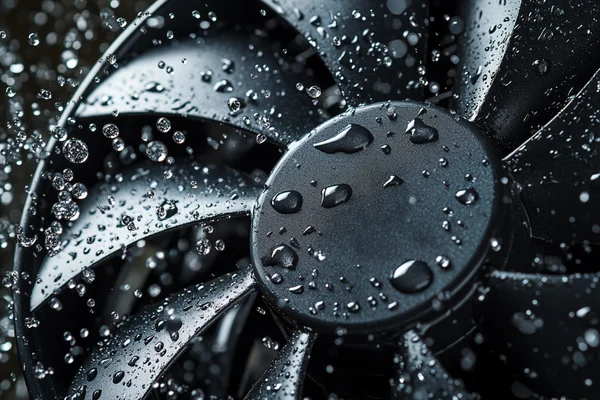
Engineers and purchasing managers often face confusion over what "waterproof" truly means for a cooling fan. A common misconception is that a higher IP rating is always better, which can lead to overspending on unnecessary protection. Conversely, under-specifying a fan can result in premature field failures and expensive warranty claims. This guide provides a clear framework for interpreting waterproof ratings, enabling you to make an informed, cost-effective decision for your project.
Table of Contents
Why Does Waterproofing Matter for Your Fan?
Without adequate protection, dust and moisture can easily destroy a standard fan,1 which can lead to thermal runaway and cause your entire system to overheat and fail.2 A fan with the correct environmental sealing is necessary to prevent this.
Waterproofing shields a fan's internal motor and electronics from damage. This protection prevents electrical short circuits from moisture ingress and stops abrasive dust from contaminating the bearing system. It is essential for ensuring long-term reliability in any environment that is not consistently clean and dry.
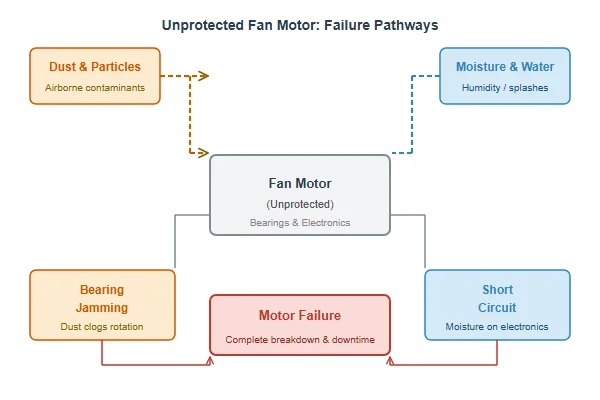
When an unprotected fan operates in a contaminated environment, the most common failures are bearing seizure and electrical shorts. Fine dust acts as an abrasive within the bearings, accelerating wear, increasing noise, and eventually causing the rotor to lock up. Moisture presents an even greater risk, as it can create a short circuit on the fan's printed circuit board (PCB), causing immediate failure. Even sustained high humidity can lead to corrosion that weakens electrical connections over time. A properly rated waterproof fan is a form of risk management, incorporating design features like sealed motors or conformally coated circuit boards to mitigate these specific failure modes and ensure your equipment operates as designed.
How Does the IP Rating System Actually Work?
The Ingress Protection (IP) rating system can appear complex, but a misunderstanding of its structure can lead to poor purchasing decisions. The system is straightforward once you understand its two components.
The IP rating is made of two separate digits,3 each representing a distinct level of protection. The first digit (0-6) rates the enclosure's effectiveness against solid foreign objects, from fingers to microscopic dust. The second digit (0-8) rates its effectiveness against the ingress of water. These two ratings are independent.
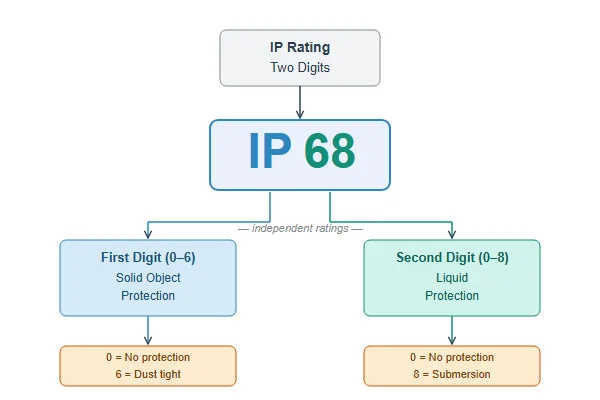
A fan's protection against solids does not correlate with its protection against liquids. You must evaluate both numbers to understand the fan's full capabilities. For example, a fan with an IP62 rating is completely dust-tight (the '6') but is only protected against dripping water (the '2'). Conversely, an IP18-rated fan would offer minimal protection from solids (the '1') but could withstand continuous submersion in water (the '8'). The first step in selection is to identify the primary environmental threat in your application. Whether it's fine airborne particulates in a workshop or wash-down spray in a food processing plant will determine which digit of the IP rating is more critical for your design.
IP Rating Chart Breakdown4
| First Digit (Solids) | Protection Against | Second Digit (Liquids) | Protection Against |
|---|---|---|---|
| 0 | No protection | 0 | No protection |
| 1 | Objects >50mm | 1 | Vertical drips |
| 2 | Objects >12.5mm | 2 | Drips at 15° angle |
| 3 | Objects >2.5mm | 3 | Water spray |
| 4 | Objects >1mm | 4 | Water splashes |
| 5 | Dust-protected | 5 | Water jets |
| 6 | Dust-tight | 6 | Powerful water jets |
| 7 | Temporary immersion | ||
| 8 | Continuous immersion |
What's the Real Difference Between IP44, IP55, IP67, and IP68?
While these common "waterproof" ratings may seem similar, selecting the wrong one leads to either overpaying for unneeded protection or risking premature equipment failure. The key difference lies in the type and intensity of liquid exposure each rating can withstand. IP44 is sufficient for splashes, IP55 for jets, IP67 for temporary immersion, and IP68 for continuous submersion.
A frequent mistake is over-specifying the IP rating. An engineer might see "IP68" and assume it is the "best" fan, selecting it for an indoor application where it will never be submerged. This decision increases component cost for no practical benefit. An IP54 fan, protected against dust ingress and light water splashes, would have been a more cost-effective and perfectly suitable choice. The manufacturing processes for higher IP ratings are more complex and expensive. For instance, an IP68 fan often requires the entire motor and electronics assembly to be fully encapsulated in epoxy (potting), while an IP55 fan may only require a conformal coating on its PCB. Both methods are effective for their intended environments, but potting is a more involved and costly process. A proper analysis of the operating environment is essential to avoid this common purchasing error.
Common IP Rating Comparison
| IP Rating | Solids Protection | Liquids Protection | Common Misconception |
|---|---|---|---|
| IP44 | Protected from objects >1mm | Protected from splashes from any direction. | Sufficient for outdoor use. (Incorrect; cannot withstand rain or jets.) |
| IP55 | Dust-protected (limited ingress) | Protected from low-pressure water jets. | Can be pressure washed. (Incorrect; not rated for high-pressure jets.) |
| IP67 | Dust-tight (no ingress) | Protected from temporary immersion (up to 1m for 30 min).5 | Can operate while submerged. (Incorrect; rated for survival, not operation.) |
| IP68 | Dust-tight (no ingress) | Protected from continuous immersion (conditions specified by supplier).6 | Always superior to IP67. (Only if continuous submersion is required.) |
What Are the Best Use Cases for Each IP Rating?
Knowing the definitions is not enough; applying them correctly is what matters. Selecting an inappropriate rating means either paying for durability you don't need or specifying a fan that will fail when exposed to its environment.
Match the IP rating to the application's real-world conditions. Use IP44 for indoor equipment exposed to splashes, IP55 for systems requiring light wash-downs, and IP67 or IP68 for equipment that will be exposed to significant rain, flooding, or submersion.
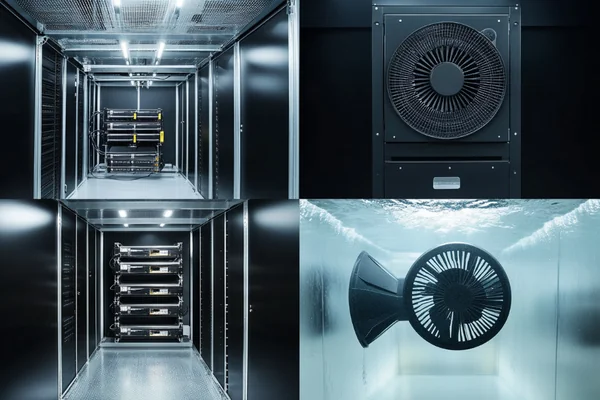
Based on common engineering applications, here are some practical examples. For an indoor control cabinet that requires protection from airborne dust and an accidental liquid spill, an IP44 or IP54 fan is typically sufficient. For equipment that is cleaned regularly, such as in food processing or industrial manufacturing, IP55 is a common baseline, as it can withstand wash-downs from a low-pressure hose.
For outdoor applications like telecom enclosures or external lighting systems, the fan must be able to handle rain and severe weather. IP67 is a strong choice, as it is completely dust-tight and can survive temporary submersion, such as during a flood or heavy storm. Finally, IP68 is reserved for the most extreme cases, such as equipment designed to operate underwater or in areas that are frequently flooded. This level of protection typically involves a fully potted motor, which provides the highest level of ingress protection but also comes at the highest cost.
How Can You Verify an IP Rating When Buying a Fan?
A supplier's datasheet may claim a high IP rating, but trusting this claim without verification can lead to product failures in the field. It is crucial to perform due diligence beyond the product specification sheet.
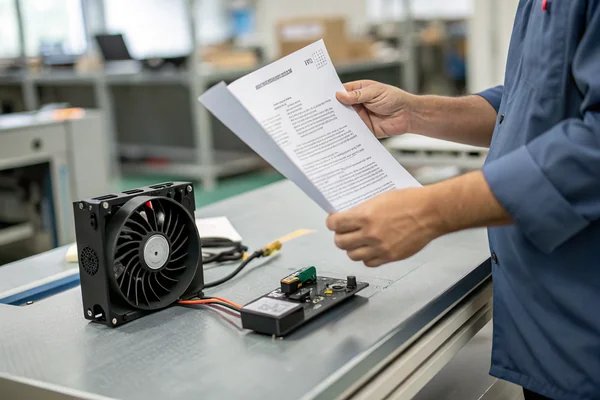
To validate a fan's environmental rating, request the official test reports that certify its IP rating. Furthermore, ask the supplier to detail the specific construction methods used to achieve that waterproofing.

A number on a datasheet is a claim, not a guarantee. To ensure a fan will perform as expected, engineers should ask two critical questions of any supplier. First, "Can you provide the third-party test report for this IP rating?" A reputable manufacturer will have this documentation readily available, proving the fan has passed standardized testing protocols. Second, ask, "How is this fan constructed to be waterproof?" The answer reveals the quality of the engineering. Is protection achieved via a light conformal coating on the PCB, suitable for humidity and splashes (e.g., IP55)? Or is the entire motor stator and electronics assembly fully potted in epoxy, creating a solid, impenetrable block suitable for submersion (e.g., IP67/IP68)? Understanding the construction method provides more insight into the fan's long-term durability than the IP rating alone and helps separate marketing claims from engineering facts.
Conclusion
Choosing the right waterproof fan is an exercise in risk management. By matching the IP rating to your specific environment and budget, and by verifying supplier claims with test reports and construction details, you can ensure the long-term reliability of your thermal management system.
"Moisture Impact on Electronics: Risks & Solutions - ZESTRON", https://www.zestron.com/en/know-how/applications-analytic/moisture-on-assemblies. A source can describe how particulate matter can cause abrasive wear and seizure in fan bearings, while moisture can lead to corrosion of electrical contacts and short circuits on the printed circuit board. ↩
"Thermal management (electronics) - Wikipedia", https://en.wikipedia.org/wiki/Thermal_management_(electronics). A source can explain that many electronic systems generate significant heat and rely on active cooling fans to maintain safe operating temperatures, and that a fan failure can quickly lead to component throttling or catastrophic system failure. ↩
"IP code - Wikipedia", https://en.wikipedia.org/wiki/IP_code. A source from a standards body like the International Electrotechnical Commission (IEC) can confirm that the IP Code, as defined in standard IEC 60529, consists of two digits that independently rate protection against solids and liquids. ↩
"IP code - Wikipedia", https://en.wikipedia.org/wiki/IP_code. A source from a standards organization or a technical guide can provide a complete chart of IP Code ratings, confirming the levels of protection against solids and liquids for each numeral as specified in IEC 60529. ↩
"IPX7 & IPX8 Water Immersion Testing | Applus+ Keystone | ISO 17025", https://keystonecompliance.com/ipx7-ipx8-water-immersion/. The IEC 60529 standard specifies that for an IPx7 rating, the enclosure must prevent harmful ingress of water when immersed under defined conditions of pressure and time, typically up to 1 meter for 30 minutes. ↩
"IPX7 & IPX8 Water Immersion Testing | Applus+ Keystone | ISO 17025", https://keystonecompliance.com/ipx7-ipx8-water-immersion/. The IEC 60529 standard states that for an IPx8 rating, the conditions for submersion are subject to agreement between the manufacturer and user, but must be more severe than those for IPx7. The manufacturer must specify the depth and duration. ↩

Liang
I've been working with DC fans for 30 years — long enough to have seen the industry evolve from basic sleeve bearing designs to today's high-efficiency, IP68-rated systems built for the harshest environments imaginable. I founded Herays because I believed manufacturers and engineers deserved a supplier who could talk technical from day one. Not just hand over a datasheet, but actually help you select the right fan for your thermal load, your enclosure, your certification requirements. Most of what I write here comes directly from problems I've solved on the factory floor or in customer applications — medical devices, laser equipment, industrial automation, you name it. If it involves moving air efficiently and reliably, I've probably spent time thinking about it. When I'm not obsessing over airflow curves, I'm usually helping a customer figure out why their cooling system isn't performing the way their simulation said it would.
View all posts by Liang