A loud fan can degrade the user experience, making an otherwise high-quality product feel cheap or distracting. For engineers and product designers, selecting a quiet cooling solution is a critical design challenge.
The quietest DC axial fan is not simply the one with the lowest dBA rating on its datasheet. The best choice is a fan that is properly matched to your product's specific airflow resistance (system impedance) and operational profile, using a combination of the right bearing, size, and speed control.
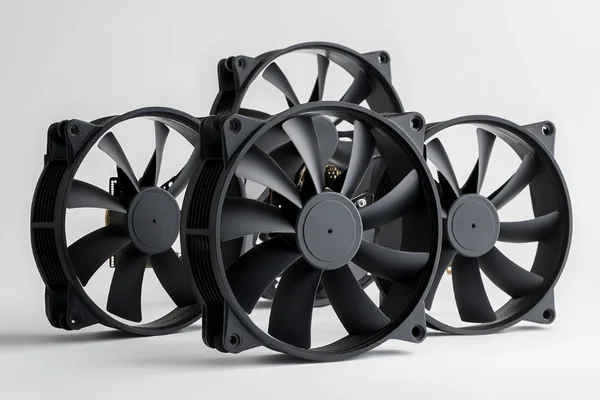
As a fan supplier, one of the most frequent requests we receive is for "the quietest fan." Experience shows that a fan's noise level on paper often has little correlation with how it sounds inside a real-world product. The secret to quiet cooling isn't just about component selection; it's about understanding how that component interacts with the entire system. This guide outlines the key questions we ask our customers to help them find a fan that is truly quiet where it matters most: inside their device. It's time to look beyond the datasheet.
Table of Contents
Why Fan Noise Matters
Excessive fan noise can significantly detract from a product's user experience. The constant hum or whine can be a deal-breaker for customers who expect quiet operation in their home, office, or industrial environment.
Fan noise matters because it directly impacts user experience, perceived product quality, and, in some sectors, regulatory compliance. A loud fan can make an excellent device feel cheap, distracting, or irritating to use, ultimately damaging brand reputation.

Acoustic performance is a core part of the user experience. A sleek, modern piece of office equipment that constantly hums creates a disconnect between the premium design and the annoying auditory reality. This noise immediately cheapens the perception of the product, regardless of its performance. For some industries, such as medical devices or professional audio equipment, noise levels are not just a preference but a strict requirement1. Furthermore, a customer's definition of "quiet" varies by application. A low, steady airflow hum might be acceptable in an industrial setting, but a high-pitched electronic whine from the motor could be a complete deal-breaker for a consumer device used in a bedroom. Defining the acoustic goals for your specific application is the first step toward a successful design.
How to Interpret Key Noise Metrics like dBA
Fan datasheets can be misleading if not interpreted correctly. The dBA rating is a common starting point, but it doesn't provide a complete picture of how a fan will perform acoustically within your product.
A fan's dBA (A-weighted decibels) rating measures its noise level in an ideal, open-air environment2. While useful for baseline comparisons, this metric does not account for real-world factors like system impedance, which can dramatically increase audible noise.
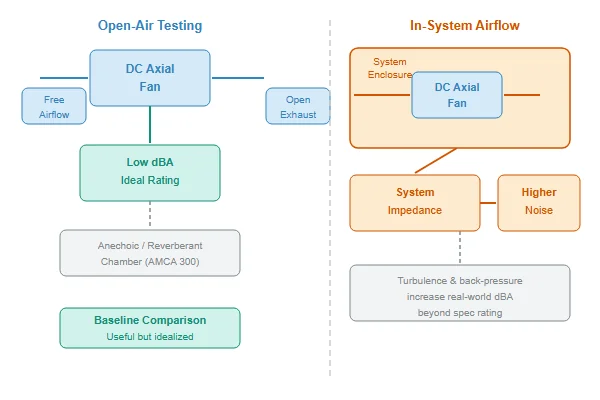
When engineers first contact us, they often request the fan with the lowest dBA rating. This is a logical starting point, but it can be misleading. The dBA value on a datasheet is measured in a controlled, anechoic chamber with zero airflow resistance. Your product, with its internal components and enclosures, is not an anechoic chamber.
Understanding System Impedance
The single biggest factor that makes a "quiet" fan loud is system impedance. This term describes anything in your device that obstructs airflow, such as:
- Dense heat sink fins
- Dust filters
- Protective grills
- Tight internal layouts and cabling
When air hits these obstacles, it creates turbulence. This turbulence, not the fan motor itself, is often the primary source of unwanted noise. A fan rated for 25 dBA in open air might generate 40 dBA of turbulent noise3 when forced to push air through a restrictive filter. This is why our first question to an engineer is always about the system's airflow path.
| System Impedance | Airflow Path | Typical Noise Profile |
|---|---|---|
| Low | Open chassis, few obstructions, wire grills. | Closer to datasheet dBA, dominated by airflow. |
| High | Dense filters, tight enclosures, radiators. | Much higher than datasheet dBA, dominated by turbulence. |
How Bearing Types Impact Noise
The choice of bearing technology is not a minor detail. The selection between sleeve, ball, and fluid dynamic bearings has a significant impact on a fan's initial acoustic signature and its long-term noise profile.
The bearing type is critical for a fan's noise profile and longevity. Sleeve bearings are quietest initially but wear out faster. Ball bearings are more durable but can introduce mechanical noise. Fluid Dynamic Bearings (FDB) offer an excellent balance of quiet operation and long life.
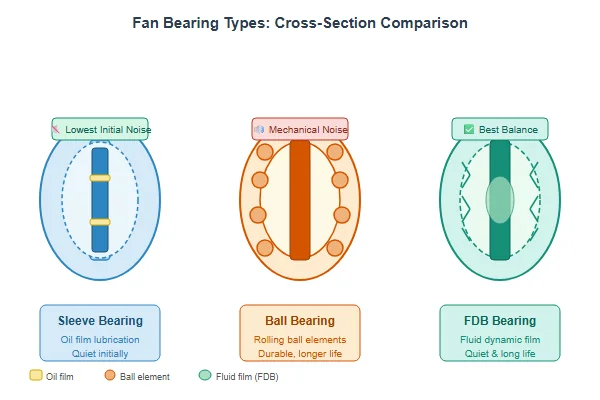
After system impedance, the fan's bearing is the next most important factor for noise. It affects not only the out-of-box sound but also how that sound will change over thousands of hours of operation. There is no single "best" bearing; the choice is a trade-off between cost, initial quietness, and long-term reliability. A common mistake is selecting a sleeve bearing for a 24/7 industrial application due to its initial low noise, only to have it fail or become noisy after a year4. Conversely, using a more expensive ball bearing in a consumer product with intermittent use might be an unnecessary expense. Understanding the product's operational life and environment is key to making the right choice.
Bearing Noise & Lifespan Comparison
| Bearing Type | Initial Noise | Long-Term Noise Profile | Lifespan | Best For... |
|---|---|---|---|---|
| Sleeve Bearing | Lowest | Can become noisy as lubricant dries out or wears. | Shorter | Low-cost, light-use consumer electronics. |
| Ball Bearing | Low to Medium | Very stable noise profile, minimal change over time. | Long | 24/7 operation, industrial equipment, high-reliability needs. |
| Fluid Dynamic (FDB) | Very Low | Stays quiet for most of its life until eventual failure. | Very Long | Premium applications wanting both quietness and long life. |
Best Practices for Noise-Optimized System Design
If your "quiet" fan is still producing excessive noise inside your product, the issue may lie not with the fan itself, but with its integration into the system.
To minimize noise, focus on system-level design rather than just the fan component. Use a larger fan spinning at a lower speed, ensure clear airflow paths, and minimize obstructions near the fan's intake and exhaust. These design changes are often more effective than simply sourcing a quieter fan.
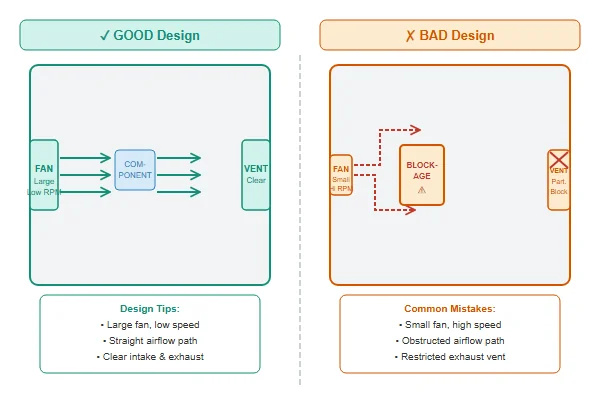
The most effective noise reduction strategies are implemented at the design stage. We have seen customers resolve noise issues not by switching to a more expensive fan, but by making a simple modification to their chassis. When you design for good airflow, you enable the fan to operate more efficiently and quietly.
Use a Larger Fan at a Lower Speed
A fundamental principle of quiet cooling is that bigger is often better. A 120mm fan spinning at 1000 RPM can move the same amount of air as an 80mm fan at 2000 RPM, but it will do so far more quietly. The lower rotational speed generates less mechanical and turbulent noise. If your design has the physical space, increasing the fan size is almost always the best first step.
Provide Adequate Clearance for Airflow
Fans perform poorly when objects are placed directly in their airflow path. Placing a component, wire bundle, or chassis wall too close to the fan's intake (the center hub) or exhaust (the blade tips) creates significant turbulence and noise. A good rule of thumb is to maintain a clearance of at least one-third of the fan's diameter5. For a 92mm fan, this translates to a clear space of about 30mm around the fan.
Isolate Vibrations
A fan's mechanical vibration can be transmitted to the chassis, causing panels to resonate and amplify the noise. Screwing a fan directly to a thin metal or plastic panel is a common source of this structure-borne noise. Using soft silicone or rubber anti-vibration mounts instead of metal screws can decouple the fan from the chassis and stop this vibration6 effectively.
What to Look for in the Quietest DC Axial Fans
Searching for the single quietest fan on the market can be a misleading goal. The best choice is always relative to your specific application's requirements.
The "quietest" fan is the one that best matches your system's impedance and operational needs. Look for a fan with a wide PWM control range, the appropriate bearing for your lifespan requirements, and a blade design optimized for your system's airflow characteristics.
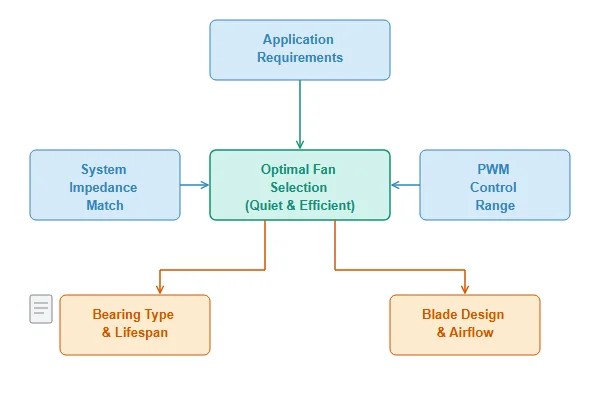
After assisting hundreds of engineers with this exact problem, we can confirm there is no universally quiet fan. The selection process is about managing trade-offs and asking the right questions before committing to a design. The goal is to find the fan that will be quietest in your product, not just on a spec sheet. When a customer asks for our quietest fan, we begin a conversation to define their real requirements.
You can do the same internally with this checklist:
- What is my system impedance? Is the design an open-air enclosure (low impedance) or does it require pushing air through dense fins and filters (high impedance)? This determines whether you need a fan built for airflow or static pressure7.
- What is the required lifespan? Will the product run 24/7 for five years, or a few hours a week? This guides the bearing choice (e.g., Ball Bearing for 24/7 vs. Sleeve for intermittent use).
- What type of noise is most disruptive? Is a low hum of airflow acceptable, while a high-pitched motor whine is not? This can influence motor driver and blade design choices.
- Do I need precise speed control? A fan with a wide PWM control range8 allows you to create a custom fan curve, running the fan silently at idle and only ramping it up when absolutely necessary.
- What are my physical space constraints? Can the design accommodate a larger, slower-spinning fan, or is it restricted to a smaller, high-speed model?
Answering these questions transforms the search from "find the lowest dBA" to "find the fan with the optimal characteristics for my system."
Conclusion
Choosing a quiet DC axial fan is an exercise in system-level thinking. By understanding system impedance, bearing technology, and design integration, you can select a fan that delivers truly quiet and reliable cooling performance matched to your product's specific needs.
"Recognized Consensus Standards: Medical Devices - FDA", https://www.accessdata.fda.gov/scripts/cdrh/cfdocs/cfStandards/detail.cfm?standard__identification_no=40209. For example, the international standard for medical electrical equipment, IEC 60601-1, includes requirements and testing procedures related to acoustic noise to ensure patient and operator comfort and safety. ↩
"ANSI/AMCA Standard 300-08 Reverberant Room Method for Sound ...", https://www.academia.edu/42884092/The_International_Authority_on_Air_System_Components_ANSI_AMCA_Standard_300_08_Reverberant_Room_Method_for_Sound_Testing_of_Fans. Industry standards, such as ISO 10302, specify the methodology for measuring fan noise, which involves testing in a standardized acoustic environment (like an anechoic chamber) to ensure comparable results across manufacturers. ↩
"Aerodynamic noise characteristics of a centrifugal fan in high ...", https://pmc.ncbi.nlm.nih.gov/articles/PMC10795985/. Experimental studies show that as system impedance increases, a fan's operating point shifts, which can lead to flow separation and turbulence, causing a significant rise in sound pressure level, sometimes by 10-15 dBA or more compared to its free-air rating. ↩
"Ohmmeter senses depletion of lubricant in journal bearings", https://ntrs.nasa.gov/citations/19640000018. Reliability studies on sleeve bearings show that their lifespan is often limited by the degradation or depletion of their lubricant, which occurs faster at higher temperatures and continuous operation, leading to increased friction, noise, and eventual seizure. ↩
"[PDF] Improving Fan System Performance - A Sourcebook for Industry", https://docs.nrel.gov/docs/fy03osti/29166.pdf. Fan manufacturers and thermal design guides often recommend maintaining a minimum clearance around the fan's inlet and outlet to prevent flow separation and turbulence, which degrade performance and increase noise. The exact recommendation varies but is often related to the fan's diameter. ↩
"Vibration isolation - Wikipedia", https://en.wikipedia.org/wiki/Vibration_isolation. The principle of vibration isolation explains that by using a flexible mounting (like rubber or silicone), the transmission of vibrational energy from the fan motor to the chassis can be significantly reduced. This is most effective when the mount's natural frequency is much lower than the fan's rotational frequency, preventing the chassis from resonating and amplifying structure-borne noise. ↩
"What is the difference between "airflow fans" and "[static pressure](https://herays.com/dc-axial-fan-cfm-vs-static-pressure/) ...", https://www.reddit.com/r/hardware/comments/hgq4x8/what_is_the_difference_between_airflow_fans_and/. Fan engineering principles show that blade design is a trade-off. Fans designed for high airflow (low impedance) typically have fewer, steeply pitched blades, while fans for high static pressure (high impedance) often have more, wider, and more curved blades to maintain pressure against resistance. ↩
"[PDF] 4-Wire Pulse Width Modulation (PWM) Controlled Fans Specification", https://glkinst.com/cables/cable_pics/4_Wire_PWM_Spec.pdf. The 4-wire Pulse Width Modulation (PWM) fan control specification, widely adopted in the electronics industry, defines a standard for dynamically adjusting a fan's rotational speed. A dedicated control signal allows a system to command a fan to operate anywhere from its minimum to maximum RPM, enabling quiet operation at low loads and high performance when needed. ↩

Liang
I've been working with DC fans for 30 years — long enough to have seen the industry evolve from basic sleeve bearing designs to today's high-efficiency, IP68-rated systems built for the harshest environments imaginable. I founded Herays because I believed manufacturers and engineers deserved a supplier who could talk technical from day one. Not just hand over a datasheet, but actually help you select the right fan for your thermal load, your enclosure, your certification requirements. Most of what I write here comes directly from problems I've solved on the factory floor or in customer applications — medical devices, laser equipment, industrial automation, you name it. If it involves moving air efficiently and reliably, I've probably spent time thinking about it. When I'm not obsessing over airflow curves, I'm usually helping a customer figure out why their cooling system isn't performing the way their simulation said it would.
View all posts by Liang