A fan that runs flawlessly in the lab can be dead within a season once it's on a boat or bolted to outdoor equipment -- indoors and outdoors are really two different products.
- Even a well-made standard DC fan will often fail within months outdoors or at sea, from things a datasheet never covers, like corrosion and UV degradation.
- Real marine-grade protection is more than an IP rating -- it needs specific materials and processes like conformal coating and motor potting to actually resist salt and humidity.
- IP67 or IP68 is table stakes for anything exposed to spray, rain, or possible submersion, but the rating alone doesn't guarantee it'll survive corrosion long-term.
- Standard fan plastics like PBT or ABS go brittle and crack under prolonged sun. Look for housings and blades with UV inhibitors built in.
- I'd rather see a supplier's salt-spray and thermal-cycling test data than another spec sheet comparison when the application is genuinely critical.
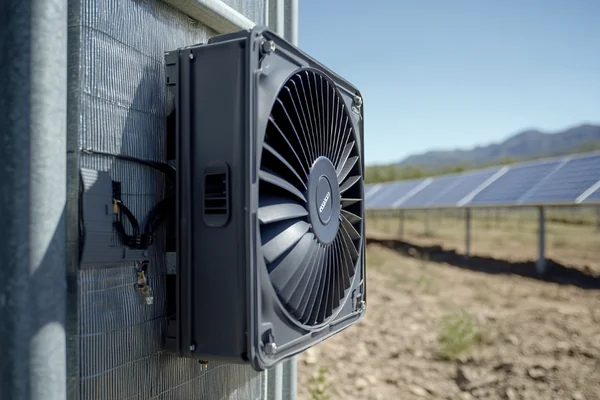
I’ve been working with DC fans for 30 years, and one of the most common points of failure I see comes from a simple mistake: using an indoor-rated fan in an outdoor application. An engineer will spec a fan that works perfectly in the lab, but once it’s installed on a boat, in outdoor telecom equipment, or on agricultural machinery, it’s dead in a single season. The problem is that the challenges outside aren't just about water; it's a combination of salt, humidity, UV radiation, and constant temperature swings that attack a fan from every angle.
A fan designed for a server room and a fan meant for a ship's deck may look similar, but I can assure you, they are completely different animals. Choosing the right one comes down to understanding what will actually destroy it in the field.
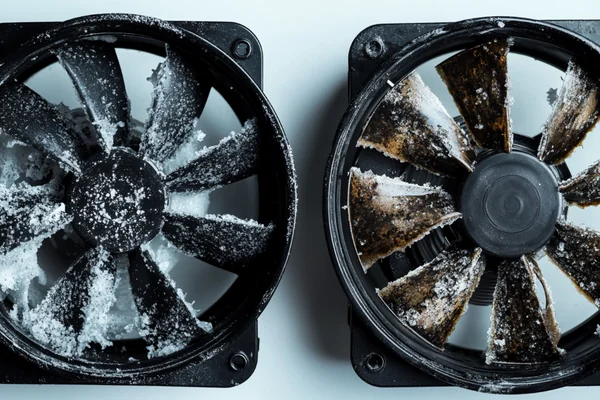
Table of Contents
What Are the Biggest Challenges in Harsh Outdoor Environments?
When I help a customer spec a fan for outdoor use, I'm not just thinking about rain. The real-world environment presents a multi-front attack that a standard fan is not built to withstand.
- Moisture & Humidity: This is the most obvious one. Water getting into the motor or onto the PCB will cause a short circuit. High humidity alone can lead to condensation and corrosion over time.
- Salt Spray: For any marine or coastal application, this is the number one killer. Salt-laden air is incredibly corrosive. It will eat away at motor windings, PCB traces, and bearing surfaces far faster than fresh water.
- UV Radiation: The sun’s ultraviolet rays break down the polymer chains in standard plastics. A fan housing made from regular PBT or ABS will become brittle, discolor, and eventually crack and fall apart after a year or two in direct sunlight.
- Temperature Extremes & Cycling: Outdoor equipment can bake at 60°C in the sun and drop below freezing overnight. This constant expansion and contraction stresses the fan’s seals, housing, and internal components, accelerating wear and creating pathways for moisture to get in. You can learn more about how this impacts fan life in my guide to DC fan operating temperature ranges.
- Dust & Dirt: In agricultural or industrial settings, airborne dust can work its way into the motor assembly, especially if the fan isn't properly sealed. This abrasive material will destroy the bearings and can cause the motor to seize.
How Do You Deal with Corrosion from Salt Air and Humidity?
Stopping corrosion is about creating a complete barrier between the sensitive electronics and the hostile environment. On the factory floor, I’ve seen firsthand that just putting a fan in a "waterproof" case isn't enough; the protection has to be built into the fan itself.
The two most critical areas to protect are the motor and the printed circuit board (PCB).
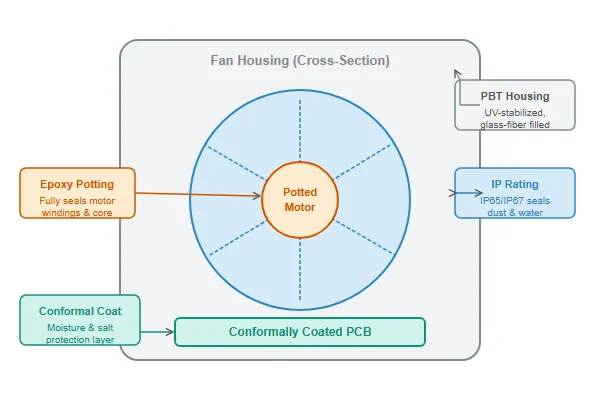
- Motor & Winding Protection: For the highest level of protection, I insist on a fully potted motor. This process involves completely encapsulating the motor's copper windings and the electronic driver components in a solid block of thermally conductive epoxy resin. This creates an impenetrable, void-free barrier against moisture and salt, leaving nothing exposed.
- PCB Protection: The PCB is the fan's brain. Even if the motor is sealed, moisture on the PCB will cause failure. The solution is a process I've specified for countless ruggedized designs: conformal coating. This is a thin, transparent polymer film that is applied over the entire circuit board. It's a non-conductive layer that physically shields all the solder joints, traces, and components from moisture and contaminants.
Without both of these features, a fan in a marine environment is living on borrowed time.
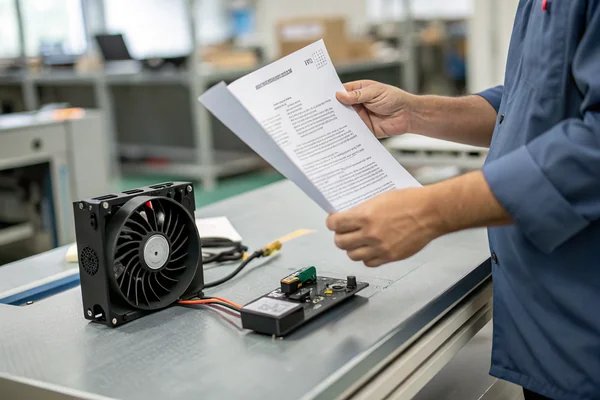
With over 20 years of experience, I know that just claiming a fan is "weatherproof" isn't enough. It has to be proven. That's why I invested in our own in-house salt spray test system, alongside temperature cycling chambers. When a customer needs a fan for a marine application, we can provide test data based on standards like ASTM B117, not just a datasheet spec. It’s this level of validation, backed by our ISO 9001 and IATF 16949 quality systems, that gives engineers the confidence that our parts will survive in the field, because we've already simulated those harsh conditions right here in our factory.
What IP Rating Is Really Needed for Marine Use?
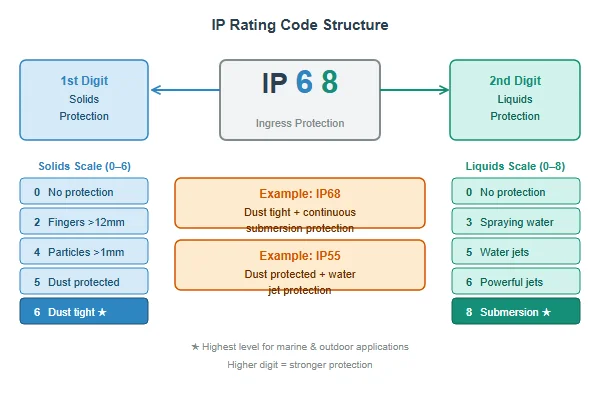
The Ingress Protection (IP) rating is a critical starting point, but you have to choose the right level for the application. My guide to waterproof fans covers this in more detail, but for outdoor and marine use, I generally point engineers to three key levels defined by the IEC 60529 standard1.
- IP55: Protected against dust and low-pressure water jets from any direction. This is suitable for equipment in a sheltered outdoor location, like under an awning or inside a larger, weather-resistant enclosure where it might see some spray but no direct, heavy rain.
- IP67: Completely dust-tight and protected against temporary immersion in water (up to 1 meter for 30 minutes). This is a solid baseline for many marine applications where the fan might get hit by waves or be installed in a bilge area prone to temporary flooding.
- IP68: Completely dust-tight and protected against continuous submersion under conditions specified by the manufacturer. This is the highest level of protection I specify for components that will be fully exposed on a ship's deck, on underwater equipment, or in any area where it could be submerged for long periods.
The key is to match the rating to the real-world risk. Over-specifying can add unnecessary cost, but under-specifying is a guarantee of field failure.
What Kind of Housing Material Resists UV Degradation?
I've seen fan blades become so brittle from sun exposure that they shatter during operation. This is a direct result of using the wrong plastic. Standard PBT (polybutylene terephthalate), while strong and common for fan housings, has poor resistance to UV radiation.
For any application with direct sun exposure, you must specify a material with a UV inhibitor. This additive works by absorbing or reflecting UV radiation, protecting the plastic's molecular structure.
Here’s how the common material options I work with stack up:
| Material | UV Resistance | Strength | Typical Use Case |
|---|---|---|---|
| Standard PBT | Poor | Good | Indoor electronics, server rooms |
| PBT + UV Inhibitor | Excellent | Good | Outdoor enclosures, marine electronics, solar equipment |
| Standard ABS | Poor | Moderate | Consumer electronics (indoor) |
| ASA | Excellent | Good | Automotive exterior parts, premium outdoor gear |
For most industrial and marine fan applications, PBT with a glass-fiber fill (for strength) and a UV inhibitor is the material I recommend. It offers the best balance of durability, chemical resistance, and cost-effectiveness for surviving long-term outdoor exposure.
What Specs Should I Look for in a Marine DC Fan?
When an engineer comes to me for a fan that has to survive on the water, I run through a specific checklist that goes far beyond just airflow and size.
- IP Rating: IP67 minimum for most applications, IP68 for fully exposed or submersible locations.
- Motor Protection: The datasheet must specify a fully potted or encapsulated motor. If it doesn't say this explicitly, assume it's not protected.
- PCB Protection: A conformally coated PCB is non-negotiable.
- Bearing Type: Only sealed dual ball bearings should be used. Sleeve bearings will fail very quickly when exposed to temperature cycles and humidity.
- Housing & Blade Material: The material must be listed as UV-resistant (e.g., PBT+GF with UV inhibitor).
- Salt Spray Test Data: Ask the supplier for a test report. A reputable manufacturer should be able to provide data showing how many hours the fan survived in a salt spray chamber, typically tested to a standard like ASTM B1172.
- Voltage: Ensure the fan's voltage matches the vessel's or equipment's power system. Most marine applications use 12V or 24V DC systems.
Checking these seven points will help you filter out the 99% of fans that are not built for the job and focus on the few that are truly engineered to last.
FAQ
What is the difference between waterproof and marine-grade? In my experience, "waterproof" typically just refers to the fan's IP rating against water ingress. "Marine-grade" is a much higher standard that implies it is not only waterproof (e.g., IP67/68) but also built with materials and protections—like conformal coating and UV-inhibited plastics—to resist long-term corrosion from salt and degradation from sunlight.
Can I use a standard IP67 fan on a boat? You can, but I wouldn't recommend it for anything critical. A standard IP67 fan might keep water out of the motor for a while, but it likely lacks protection against salt fog corrosion and UV damage. These are often the true causes of failure, and they will destroy a fan that isn't specifically designed to resist them.
What is conformal coating on a fan? It's a thin, protective polymer layer that I specify to be applied directly onto the fan's printed circuit board (PCB). It acts like a transparent, non-conductive shield, protecting the delicate electronic components, solder joints, and traces from failure due to moisture, humidity, and salt contamination.
How long should a marine-rated fan last? The lifespan is still primarily determined by its bearings, but a proper marine-grade fan using high-quality, sealed dual ball bearings should have a rated life (L10) of 50,000 to 70,000 hours. A standard, unprotected fan might not even last 1,000 hours in the same environment before failing due to corrosion.
Is a higher price a guarantee of better outdoor performance? Not automatically, but the specialized materials and manufacturing processes required for a true marine-grade fan—motor potting, conformal coating, UV-stabilized plastics, and sealed ball bearings—are inherently more expensive than standard components. A very cheap "waterproof" fan has likely cut corners in one of these critical areas. You should always verify the specs, not just trust the price.
"IEC 60529 IP Ratings – Ingress Protection Standard", https://e-labsinc.com/specs-ies-60529.shtml. This standard from the International Electrotechnical Commission defines the classification system for the degrees of protection provided by enclosures of electrical equipment. ↩
"ASTM B117: Standard Practice for Operating Salt Spray (Fog) Apparatus", https://www.q-lab.com/corrosion/corrosion-test-standards/astm-b117. This standard from ASTM International establishes the apparatus, procedure, and conditions required to create and maintain a salt spray (fog) test environment for corrosion testing. ↩

Liang
I've been working with DC fans for 30 years — long enough to have seen the industry evolve from basic sleeve bearing designs to today's high-efficiency, IP68-rated systems built for the harshest environments imaginable. I founded Herays because I believed manufacturers and engineers deserved a supplier who could talk technical from day one. Not just hand over a datasheet, but actually help you select the right fan for your thermal load, your enclosure, your certification requirements. Most of what I write here comes directly from problems I've solved on the factory floor or in customer applications — medical devices, laser equipment, industrial automation, you name it. If it involves moving air efficiently and reliably, I've probably spent time thinking about it. When I'm not obsessing over airflow curves, I'm usually helping a customer figure out why their cooling system isn't performing the way their simulation said it would.
View all posts by Liang