EC fans get pitched as the obvious upgrade over standard DC fans, and in some applications that's true. In plenty of others, the efficiency gain never comes close to paying back the added cost, and the "obvious" upgrade turns out not to be obvious at all.
EC fans generally use more sophisticated motor control than standard DC fans, achieving higher energy efficiency, but the real-world payback depends heavily on runtime hours and local electricity cost -- for many applications, the efficiency gain never fully offsets the higher upfront price.
- An EC (electronically commutated) fan uses a more sophisticated motor control approach than a standard DC fan, generally delivering higher efficiency at a given airflow output.
- EC motor technology essentially combines AC motor robustness with electronic speed control, distinct from both simple brushed and standard brushless DC designs.
- The real energy consumption gap between DC and EC fans varies by application, and is most significant in continuous, high-runtime scenarios.
- Whether the 5-year cost favors DC or EC depends on runtime hours, local electricity rates, and the upfront price premium -- there's no universal answer.
- Upgrading from DC to EC makes the most sense for continuous-duty, high-runtime applications where electricity cost accumulates enough to offset the higher unit price.
Comparing DC and EC fans fairly means running the actual numbers for your specific runtime and electricity cost, not assuming EC is automatically the better choice.
Table of Contents
What Exactly Is an EC Fan, and How Is It Different?
EC fans occupy a specific middle ground in motor technology that's worth understanding clearly.
An EC (electronically commutated)1 fan uses a brushless motor with more sophisticated integrated electronic control than a standard DC brushless fan, often supporting features like built-in speed control, feedback signals, and higher overall efficiency across a range of operating conditions.
Where EC Sits Relative to Standard DC Fans
Both EC and standard brushless DC fans use electronic commutation rather than physical brushes, so the fundamental wear-mechanism advantage over brushed motors applies to both. The distinction is in the sophistication of the control electronics -- EC motors typically integrate more advanced control logic, often supporting a wider input voltage range (sometimes AC-compatible) and more precise efficiency optimization across the operating range than a typical standard DC fan's simpler driver circuit.
| Factor | Standard DC Fan | EC Fan |
|---|---|---|
| Commutation | Electronic (brushless) | Electronic (brushless), more sophisticated |
| Typical efficiency | Good | Generally higher |
| Typical unit cost | Lower | Higher |
| Control sophistication | Basic PWM/voltage | Often integrated advanced control |
How Does EC Motor Technology Actually Achieve Better Efficiency?
The efficiency gain comes from real engineering differences in how the motor is controlled, not marketing positioning.
EC motor technology achieves better efficiency through more precise electronic commutation timing and control algorithms that reduce switching and conversion losses compared to simpler standard DC fan driver circuits, particularly across a range of speeds rather than just at one fixed operating point.
Why the Efficiency Advantage Compounds Across the Speed Range
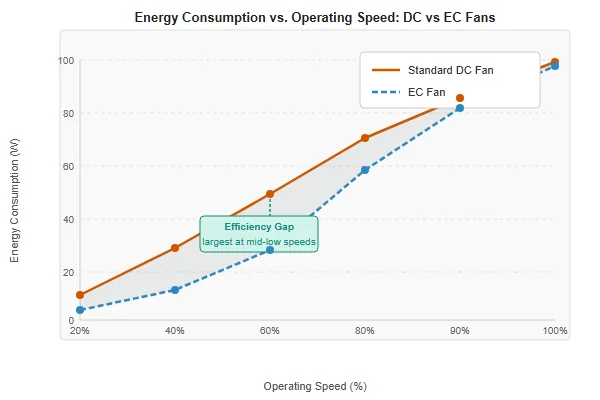
A simpler DC fan driver circuit may be reasonably efficient at its designed operating point but lose efficiency more significantly when run at reduced speed or under varying load. EC motor control is generally engineered to maintain good efficiency across a broader range of operating conditions, which matters most in applications where the fan doesn't run at a single fixed speed continuously, but instead varies with actual demand.
How Much Energy Do DC and EC Fans Actually Use in Practice?
The real gap depends heavily on the specific application and how the fan is actually used.
The real-world energy consumption gap between DC and EC fans varies significantly by application, generally ranging from a modest few percent to a more meaningful double-digit percentage difference in applications with variable speed operation across a wide range -- the gap tends to be smaller for fans running at a single, well-optimized fixed speed.
Why the Gap Isn't a Fixed Number
A fan running continuously at one well-chosen fixed speed, where a standard DC fan's driver was already reasonably well optimized for that specific point, may show a fairly modest efficiency gap versus an EC equivalent. A fan that varies speed frequently across a wide range -- HVAC applications are a classic example -- tends to show a larger real-world efficiency advantage for EC technology, since standard DC drivers often aren't as well optimized across that full variable range.
What's the Real 5-Year Cost Comparison Between DC and EC?
The total cost comparison depends on three variables that need to be run through together, not assumed.
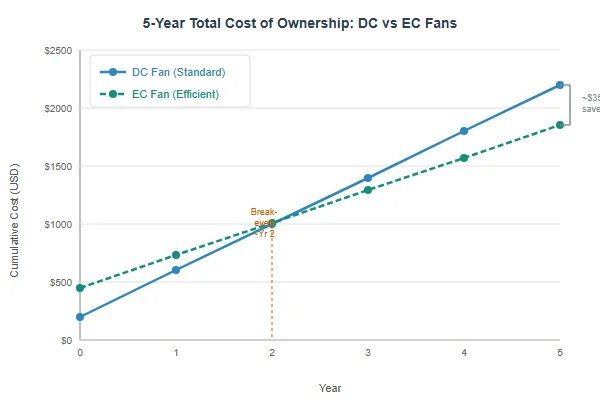
A real 5-year cost comparison requires multiplying the actual energy consumption difference by your local electricity rate and expected runtime hours, then comparing that cumulative savings against the EC fan's upfront price premium -- the answer genuinely varies by application rather than favoring one technology universally.
Running the Actual Numbers
For a fan running continuously (24/7) in a region with moderate-to-high electricity costs, even a modest per-unit efficiency gain can accumulate into real savings over 5 years, potentially exceeding the EC price premium. For a fan running intermittently, in a low-electricity-cost region, or at a speed where the DC-versus-EC gap is small to begin with, the same price premium may never fully pay back within a reasonable timeframe. This is genuinely worth calculating explicitly for your specific application rather than assuming either technology is automatically the more economical choice.
When Does Upgrading From DC to EC Actually Pay Off?
The clearest payoff scenarios share some common characteristics worth checking for.
Upgrading from DC to EC pays off most clearly in continuous-duty, high-runtime applications with variable speed operation and moderate-to-high electricity costs -- HVAC systems, continuously operating industrial equipment -- where the cumulative energy savings over the fan's service life has the best chance of exceeding the higher upfront cost.
Recognizing a Genuine EC Upgrade Case
The strongest case for EC involves fans that run nearly continuously, operate across a variable speed range rather than one fixed point, and sit in an environment where electricity costs make the efficiency gain financially meaningful. Applications that don't share these characteristics -- intermittent use, fixed-speed operation, low electricity cost regions -- see a much weaker financial case for the EC premium, even though EC remains a genuinely more sophisticated technology in absolute terms.
Does EC Technology Make Sense at Small Fan Sizes Too?
EC's economic case changes meaningfully at smaller fan sizes and lower power levels.
EC technology is more commonly found in larger, higher-power fan applications where the absolute energy savings justify the added electronics cost -- at small fan sizes and low power draw, the absolute energy savings are often too small to meaningfully offset the EC control electronics' added cost.
Why Scale Changes the Economics
The added control sophistication in an EC fan carries a real component cost that's roughly similar whether the fan itself is large or small, while the actual energy savings scale with the fan's power draw -- meaning the payback economics are considerably more favorable for larger, higher-power fans than for small ones. This is a large part of why EC technology shows up predominantly in HVAC, larger industrial, and commercial applications rather than small embedded electronics cooling fans.
Is EC Always the Better Choice, or Are There Real Downsides?
EC isn't a strictly better technology in every dimension -- it comes with real tradeoffs worth weighing.
EC fans carry real downsides alongside their efficiency advantage: higher upfront cost, sometimes more complex integration, and in some cases, more expensive or specialized replacement parts -- meaning EC isn't a universally better choice, just a better choice for specific application profiles.
Weighing the Full Picture, Not Just Efficiency
Beyond upfront cost, EC fans can sometimes involve more specialized control interfaces or replacement sourcing considerations compared to the very standardized, widely available DC fan market. For applications where efficiency genuinely matters most (continuous, high-runtime, variable speed), these tradeoffs are usually worth accepting. For applications where efficiency gains would be marginal, the added cost and complexity of EC technology may not be worth it relative to a well-chosen standard DC fan.
We've focused on DC axial and centrifugal blower fan technology for over 20 years, and when customers ask us to weigh DC against EC for a specific application, we give an honest answer based on their actual runtime and electricity cost rather than pushing one technology reflexively. Our in-house CFM, static pressure, and efficiency testing, part of our ISO 9001 and IATF 16949 quality process, lets us provide real energy consumption data for our DC fan lines so you can run an accurate comparison against EC alternatives for your specific application.
FAQ
Can an EC fan be a direct drop-in replacement for a standard DC fan?
Sometimes, but not always -- confirm voltage compatibility, control signal requirements, and physical mounting match before assuming a direct swap, since EC fans sometimes use different control interfaces.
Do EC fans require special control electronics to operate?
Many EC fans include integrated control electronics accepting standard control signals, though some advanced features may require compatible control systems to fully utilize.
Is EC technology more common in AC or DC fan applications?
EC technology appears in both, though it's particularly associated with applications that traditionally used AC motors (like HVAC), where EC offers a more efficient electronically-controlled alternative.
Does EC fan technology reduce noise as well as energy consumption?
Not inherently -- noise depends on bearing type, blade design, and operating speed regardless of motor technology, though EC's more precise speed control can help by avoiding unnecessarily high speeds.
How do I calculate whether EC makes financial sense for my specific application?
Multiply your fan's actual power draw difference (DC versus EC, at your real operating conditions) by your electricity rate and expected annual runtime hours, then compare the cumulative savings over your expected service life against the EC price premium.
Is EC fan technology likely to become the standard over time, replacing DC fans generally?
In applications where efficiency and variable-speed operation matter most, EC adoption continues to grow, though standard DC fans remain the practical choice for a large range of applications where the efficiency gain doesn't justify the added cost.
The DC-versus-EC efficiency question doesn't have a universal answer -- it depends on your actual runtime hours, electricity cost, and whether your application genuinely uses variable-speed operation, and running those real numbers beats assuming either technology is automatically better. At Herays, our Dongguan facility has built DC axial and centrifugal blower fans for over 20 years, validated under ISO 9001 and IATF 16949 certification, and we're glad to provide real efficiency data to help you run an honest comparison for your specific application.
EC (electronically commutated) motors are a category of brushless motor with more sophisticated integrated control electronics, often supporting wider voltage compatibility and more precise efficiency optimization across a range of speeds than simpler brushless DC driver designs. ↩

Liang
I've been working with DC fans for 30 years — long enough to have seen the industry evolve from basic sleeve bearing designs to today's high-efficiency, IP68-rated systems built for the harshest environments imaginable. I founded Herays because I believed manufacturers and engineers deserved a supplier who could talk technical from day one. Not just hand over a datasheet, but actually help you select the right fan for your thermal load, your enclosure, your certification requirements. Most of what I write here comes directly from problems I've solved on the factory floor or in customer applications — medical devices, laser equipment, industrial automation, you name it. If it involves moving air efficiently and reliably, I've probably spent time thinking about it. When I'm not obsessing over airflow curves, I'm usually helping a customer figure out why their cooling system isn't performing the way their simulation said it would.
View all posts by Liang