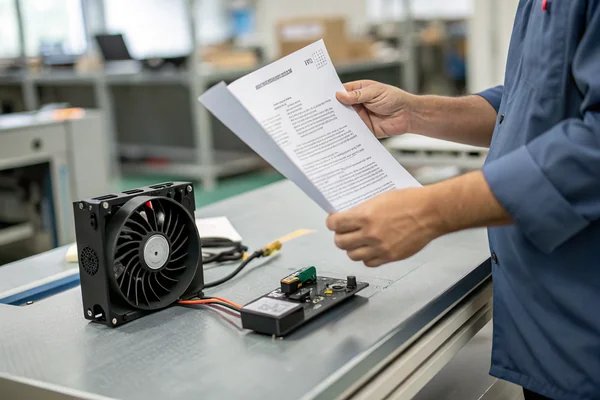
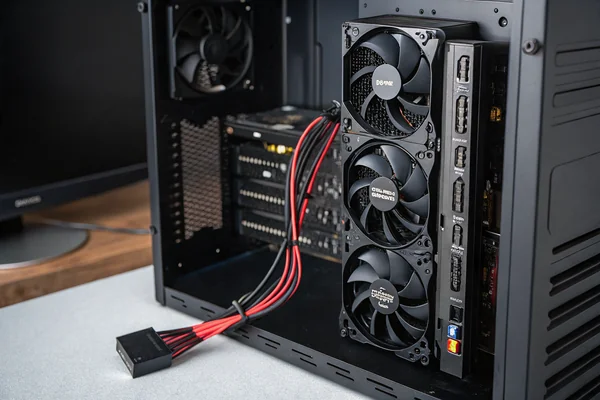
A fan running at full speed all the time isn't a design choice most engineers would make on purpose -- it's usually what happens when nobody added a way to control it. A standalone controller fixes that, often for less effort than expected.
A standalone DC fan speed controller becomes necessary when the fan's connected system doesn't already provide PWM or voltage-based speed control, letting you reduce noise and power draw during normal operation without needing the fan to run at a fixed, worst-case speed continuously.
- Not every system a fan connects to provides built-in speed control, which is exactly the gap a standalone controller exists to fill.
- Voltage-based controllers are simpler and cheaper but offer coarser control and can affect startup reliability at very low voltages.
- Standalone PWM controller modules give finer speed control and generally preserve better startup torque than pure voltage control.
- Built-in thermal control (a fan that adjusts its own speed based on an internal sensor) versus external thermal control each have real tradeoffs in flexibility and cost.
- DIY speed control with Arduino or Raspberry Pi is genuinely achievable for hobbyist and prototype projects, though it's rarely the right choice for production-scale reliability.
Getting fan speed control right often comes down to matching the controller type to what the rest of the system can actually provide.
Table of Contents
Why Would You Need a Standalone Speed Controller At All?
Speed control isn't automatic just because a fan supports it.
A standalone speed controller becomes necessary when the equipment or system a fan is installed in doesn't already provide PWM signal generation or variable voltage output, which is common in retrofit projects, simple equipment upgrades, or DIY builds where the fan is being added to a system that wasn't originally designed with variable-speed cooling in mind.
When the Gap Actually Shows Up
Plenty of equipment runs its cooling fan directly off a fixed voltage rail with no speed control logic at all, which works but means the fan runs at full speed (and full noise) continuously regardless of actual cooling need. Retrofitting variable speed control into that kind of system, or adding fan cooling to equipment that wasn't originally designed for it, is exactly where a standalone controller earns its keep -- it adds the missing control layer without requiring a redesign of the underlying equipment.
| Situation | Why a Standalone Controller Helps |
|---|---|
| Fixed-voltage-only system | Adds variable speed capability that wasn't there |
| Retrofit/upgrade project | Avoids redesigning existing equipment's control logic |
| DIY/prototype build | Provides control without custom driver circuit design |
How Do Voltage-Based Speed Controllers Actually Work?
Voltage control is the simpler, older approach to varying fan speed.
A voltage-based speed controller varies the fan's actual supply voltage to change its speed, which is mechanically simple and inexpensive but offers coarser control than PWM and can risk unreliable startup if voltage drops too low relative to the fan's minimum starting voltage.
Why Simplicity Comes With Real Tradeoffs
Reducing supply voltage directly reduces motor speed in a fairly straightforward relationship, which is why voltage control has been used for decades and remains genuinely simple to implement. The tradeoff is that fan motors have a minimum voltage below which they won't reliably start or run, and voltage control doesn't preserve full torque the way PWM does at reduced speed -- pushed too far, a voltage-controlled fan can stall or fail to start reliably, particularly under load or at cold startup.
What Do Standalone PWM Controller Modules Actually Add?
PWM controllers solve the reliability gap voltage control leaves open.
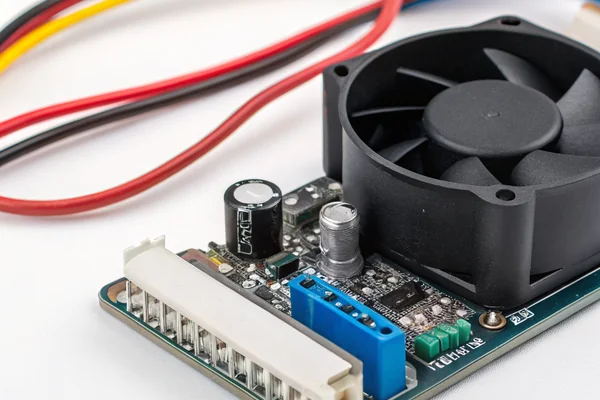
Standalone PWM controller modules generate a pulse-width-modulated1 control signal that varies fan speed by rapidly switching full voltage on and off rather than reducing it continuously, which generally preserves better startup torque and finer speed control than pure voltage-based approaches.
Why PWM Handles the Low-Speed Range Better
Because PWM control switches between full voltage and off rather than continuously reducing voltage, the fan's motor still receives full voltage during the "on" portion of each cycle, which helps maintain torque and reliable operation even at low average speeds. This is why PWM has become the more common approach for fans that need genuinely fine speed control across a wide range, from a low idle speed up to full output, without the startup reliability concerns pure voltage control can introduce.
Built-In or External Thermal Control: Which Should You Use?
Thermal-responsive speed control can live inside the fan itself or in a separate external controller, and each approach fits different situations.
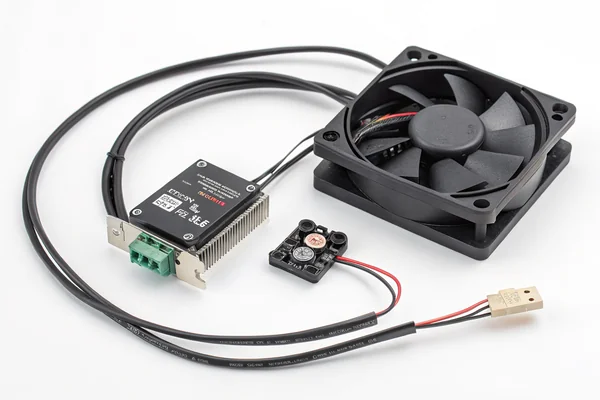
Built-in thermal control -- a fan with an internal temperature sensor adjusting its own speed -- offers simplicity and requires no external wiring, while external thermal controllers offer more flexibility, including the ability to respond to a sensor located at the actual heat source rather than at the fan itself.
Why Sensor Location Actually Matters
A fan with built-in thermal control senses temperature at its own location, which may not accurately reflect the temperature of the specific component it's meant to protect, especially if the fan sits some distance from the actual hot component. An external thermal controller lets you place the temperature sensor exactly where it matters most -- directly on a heat sink or hot component -- giving more accurate, responsive control at the cost of additional wiring and a separate component to manage.
Can You Actually Build a Reliable Fan Speed Controller With Arduino or Raspberry Pi?
DIY speed control is genuinely achievable, with real caveats about where it makes sense.
Building a fan speed controller with Arduino or Raspberry Pi is genuinely achievable for hobbyist projects and prototypes, using PWM output pins and basic driver circuitry, but production-scale applications generally need the additional reliability engineering, EMC compliance, and long-term component sourcing stability a purpose-built commercial controller provides.
Where DIY Makes Sense and Where It Doesn't
For a personal project, a prototype, or a small-scale build where iteration speed and flexibility matter more than long-term production reliability, Arduino or Raspberry Pi-based PWM control is a well-documented, accessible approach with a large community of existing examples to draw from. For a product headed to actual production and field deployment, the reliability engineering, EMC compliance validation, and long-term component availability that a purpose-built commercial controller offers usually outweighs the flexibility advantage of a DIY approach.
Does Adding a Standalone Controller Void Any Fan Warranty or Rating?
This is worth checking explicitly rather than assuming, since the answer varies by manufacturer and application.
Adding a standalone speed controller generally doesn't void a fan's warranty as long as the fan is operated within its rated voltage and speed range, though running a fan below its minimum rated startup voltage or otherwise outside its specified operating range can affect both warranty coverage and reliable performance.
Staying Within the Fan's Actual Rated Range
The practical rule is straightforward: as long as a standalone controller keeps the fan operating within its datasheet-specified voltage and speed range, it's generally not doing anything the fan wasn't designed to handle. Problems arise specifically when a controller pushes the fan outside that range -- too low a voltage for reliable operation, or speeds beyond the rated maximum -- which is a real risk with poorly configured DIY or aftermarket controllers more than with properly specified commercial ones.
What's the Real Difference Between a Cheap and a Well-Built Controller?
Controller quality affects more than just the basic speed-control function.
A well-built controller adds genuine value through cleaner PWM signal generation, better protection against electrical transients, more accurate thermal response (if applicable), and long-term reliability -- a cheap controller may technically vary fan speed while introducing electrical noise, unreliable low-speed behavior, or premature failure of the controller itself.
Why Controller Quality Compounds Over Time
A poorly designed controller can introduce electrical noise onto the PWM signal line, generate its own EMI, or fail prematurely in ways that either leave the fan stuck at one speed or, worse, cause erratic speed behavior that stresses the fan motor. For applications where consistent, reliable fan behavior actually matters, the controller deserves the same scrutiny as the fan itself, rather than being treated as an interchangeable commodity component.
We've supplied PWM-controllable fans into projects ranging from DIY prototypes to full production programs for over 20 years, and we're glad to advise on whether a standalone controller, built-in thermal control, or a custom driver solution fits your specific application best. Every PWM fan we build is validated for clean signal response and reliable low-speed operation on our in-house testing equipment as part of our ISO 9001 and IATF 16949 quality process.
FAQ
Can I use a simple potentiometer to control fan speed instead of a dedicated controller?
A potentiometer can work with a compatible voltage-control circuit, but it doesn't provide PWM control on its own -- for PWM speed control, you need a circuit that actually generates the pulse-width-modulated signal.
Does PWM control frequency matter for fan noise or performance?
Yes, to some degree -- most fans are designed for a standard PWM frequency range, and operating well outside that range can cause audible whine or inconsistent speed response.
Can a single controller manage multiple fans at once?
Many controllers support multiple fan outputs, either running them at the same speed together or with independent control channels, depending on the specific controller's design.
Is it safe to control a 4-wire PWM fan using only voltage control instead of the PWM pin?
It's possible but sacrifices the advantages of true PWM control (better low-speed torque and startup reliability) -- if the fan supports PWM, using it as designed generally gives better results.
Do standalone controllers need to match the fan's specific voltage rating exactly?
Yes, the controller needs to be compatible with the fan's rated voltage (commonly 5V, 12V, or 24V) to operate correctly and safely.
How do I know if my application needs a standalone controller versus just buying a fan with built-in thermal control?
If you need custom control logic, remote sensor placement, or integration with a broader control system, a standalone controller offers more flexibility. If simple, self-contained thermal response is enough, a fan with built-in control is often simpler.
Fan speed control is one of the more accessible upgrades available for reducing both noise and power draw, and the right controller type depends mostly on how much flexibility your application actually needs versus how much reliability engineering it can't do without. At Herays, our Dongguan facility has supplied PWM-controllable DC fans validated for clean, reliable speed response for over 20 years, under ISO 9001 and IATF 16949 certification. If you're deciding between controller approaches, we're glad to help match the right one to your project.
Pulse-width modulation varies effective power delivery by rapidly switching a signal fully on and off, adjusting the ratio of on-time to off-time rather than continuously varying voltage. For fans, this generally preserves better torque and startup reliability at low speeds than reducing supply voltage directly. ↩

Liang
I've been working with DC fans for 30 years — long enough to have seen the industry evolve from basic sleeve bearing designs to today's high-efficiency, IP68-rated systems built for the harshest environments imaginable. I founded Herays because I believed manufacturers and engineers deserved a supplier who could talk technical from day one. Not just hand over a datasheet, but actually help you select the right fan for your thermal load, your enclosure, your certification requirements. Most of what I write here comes directly from problems I've solved on the factory floor or in customer applications — medical devices, laser equipment, industrial automation, you name it. If it involves moving air efficiently and reliably, I've probably spent time thinking about it. When I'm not obsessing over airflow curves, I'm usually helping a customer figure out why their cooling system isn't performing the way their simulation said it would.
View all posts by Liang