Your product is failing from heat, and you suspect the fan. Choosing the wrong one is a costly mistake. Let's make sure you select a fan that lasts.
Most standard DC axial fans have an operating temperature range of -10°C to +70°C. This is a guideline tested in a lab, not a guarantee for your specific device. Real-world lifespan depends heavily on the fan's components, airflow blockage, and how hot your system actually gets.
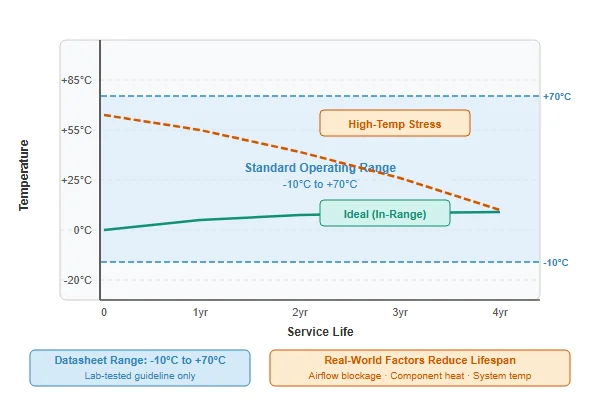
The temperature range on a datasheet is just the beginning of the story. From my experience helping engineers solve cooling problems, I know that real-world conditions are what truly matter. A fan's ability to survive depends on more than just one number. We need to look deeper at how heat affects the fan itself to understand the risk and ensure your product remains reliable. Let's break down what those numbers really mean for your design.
Table of Contents
What's the Difference Between Standard and Extended Temperature Range Fans?
You picked a standard fan for a hot device, and now it's failing. These unexpected failures damage your reputation. You need to know when an extended range fan is necessary.
Standard fans are built for typical conditions (-10°C to 70°C). Extended range fans use superior bearings, lubricant, and motor insulation to handle extreme heat or cold reliably. This upgrade is crucial for preventing early failure in harsh environments.
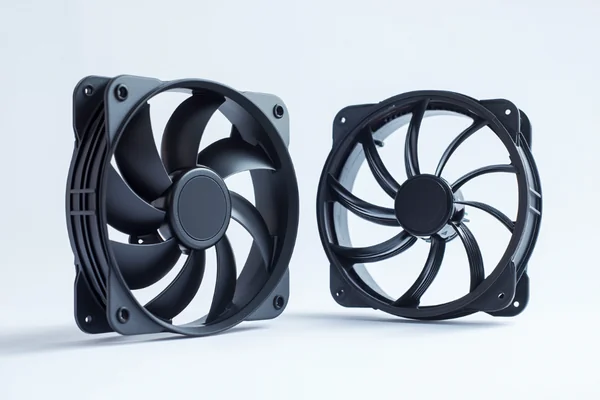
When we talk about an "extended temperature range," we're really talking about a fan built with more robust materials. The difference isn't just a number on a spec sheet; it's a physical upgrade of the components most vulnerable to heat. For a standard fan, the primary goal is a balance of cost and performance for common electronics. But for an extended range fan, the goal is survival. This means using dual ball bearings packed with special high-temperature grease instead of the oil in sleeve bearings, which would dry out quickly. The motor's internal copper windings get a higher class of insulation to prevent short circuits. Even the small electronic components on the fan's circuit board are often upgraded to industrial-grade versions that can withstand more thermal stress. It's a complete internal overhaul designed for one purpose: reliability under pressure.
| Feature | Standard Range Fan (-10°C to 70°C) | Extended Range Fan (>70°C or <-10°C) |
|---|---|---|
| Bearings | Sleeve or Standard Ball Bearings | High-Precision Ball Bearings |
| Lubricant | Standard grease/oil | High-temperature synthetic lubricant |
| Motor Insulation | Class A or B | Class F or H1 |
| IC/PCB Components | Standard-rated components | Automotive or industrial-grade components2 |
| Frame/Impeller | Standard PBT plastic | Reinforced PBT or special polymers |
Is Operating Temperature the Same as Storage Temperature?
You stored new fans in a hot warehouse all summer. You assume they're fine, but they could be damaged before you even install them. Let's clarify this common point of confusion.
No, they are different. Operating temperature is the ambient range where the fan can run safely. Storage temperature is the range for when the fan is off. The storage range is usually wider, but long-term exposure to extreme heat can still degrade the fan's lubricant.

The key difference is the fan's own motor. When a fan is running, its motor generates heat. The operating temperature spec accounts for this internal heat plus the ambient air temperature. When the fan is powered off in storage, its motor is cold. That's why the storage temperature range often looks much wider, something like -40°C to +85°C. However, this doesn't mean it's a good idea to leave fans in extreme conditions for months. The most vulnerable part is still the bearing lubricant. Even without the motor running, extreme, prolonged heat in a warehouse can cause the oil or grease in the bearings to slowly break down or separate. When you finally go to use the fan, its lifespan may have already been reduced. As a practical step, if fans have been stored in a very cold place, I always advise customers to let them acclimate to room temperature for a few hours before powering them on. This prevents any potential startup issues caused by stiff lubricant.
What Should I Consider for High-Temperature Applications Above 70°C?
Your device enclosure gets hotter than 70°C. A standard fan will get noisy and seize up, causing your entire system to fail. You need to know what to look for.
For applications above 70°C, you must use a fan with dual ball bearings, as sleeve bearing oil will fail. Also, check for a higher motor insulation class (like Class F) and ask for the fan's expected L103 lifespan at your specific operating temperature.
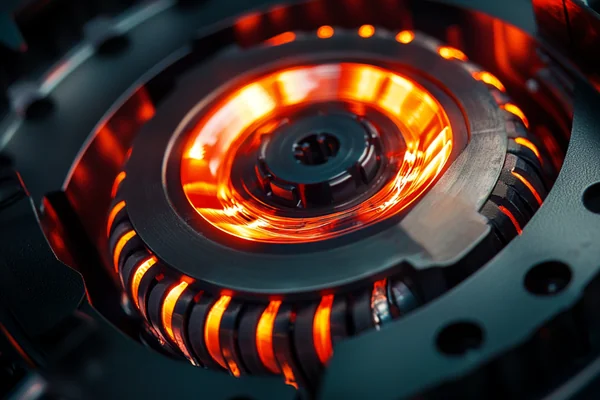
Many customers come to me after a standard fan failed in their hot industrial cabinet or densely packed electronics. The failure almost always happens in a predictable sequence. First, the lubricant in the bearings breaks down. If it’s a sleeve bearing, the oil evaporates or thickens. The fan starts to make a whirring or grinding noise, a clear sign of distress. Soon after, it seizes completely. This is why dual ball bearings are not optional for high-temperature applications; they are a requirement. Second, the heat attacks the motor's insulation. This enamel coating on the copper wires prevents short circuits. If it degrades, the motor dies. Finally, in extreme cases, the PBT plastic frame and impeller can soften and warp4. This can cause the blades to strike the housing, leading to catastrophic failure. When you talk to a supplier, don't just ask if the fan is "high-temp." Ask about the bearing type, the insulation class, and its reliability data at your target temperature.
What About Low-Temperature Applications Below -10°C?
You're designing outdoor equipment that needs to work in the winter. A fan that won't start in the cold is a serious design flaw. You must prepare for cold-related failures.
In applications below -10°C, the main danger is bearing lubricant thickening5. This can prevent the fan from starting or cause high wear. Fans with special low-temperature grease and high startup torque are essential6. Condensation and icing are also serious risks7.
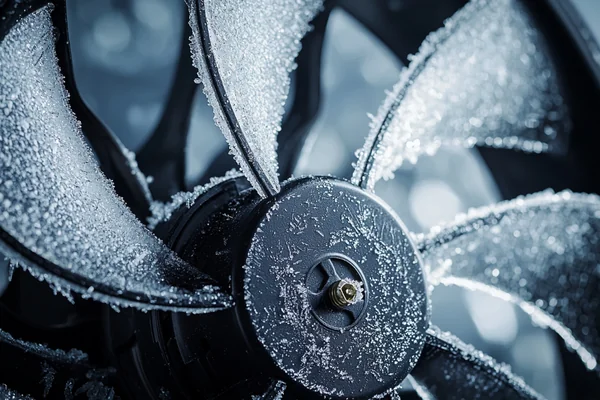
Heat gets a lot of attention, but cold is just as dangerous for a DC fan. The primary problem is the lubricant. Think of it like honey in a refrigerator—it gets thick and sticky. This increased viscosity means the fan's motor needs much more force to get the blades spinning from a standstill. If the motor's startup torque isn't strong enough to overcome this resistance, the fan simply won't start. This is a critical failure for equipment that needs immediate cooling on power-on. Even if the fan does manage to start, that initial period of high friction causes accelerated wear on the bearings until the motor's own heat warms up the grease. Another major risk is moisture. If the equipment cycles on and off in a cold, humid environment, condensation can form on the fan's circuit board. If the temperature then drops below freezing, that moisture turns to ice, which can block the blades or cause an electrical short. For these applications, we discuss options like conformal coating to protect the electronics from moisture.
How Does Temperature Really Affect Fan Lifespan and Performance?
You see a 70,000-hour lifespan on a datasheet and assume you're set. But your fans are failing in just two years. That datasheet number was misleading without the right context.
A fan's lifespan (L10) is rated at a controlled temperature, like 25°C. As a rule of thumb, every 10°C increase in operating temperature can cut the fan's expected lifespan in half. Heat kills fans by degrading the bearing lubricant and stressing electronics.
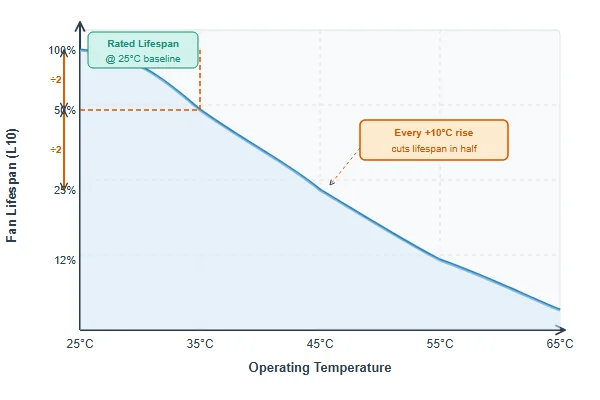
This is the most important concept I try to explain to my clients. The lifespan rating, often called "L10," is a statistical measurement. It means that in a large test batch, 10% of the fans are expected to have failed after that many hours at a specific, stable temperature (e.g., 40°C). It is not a guarantee of minimum life for every single fan. The critical part is that this lifespan is extremely sensitive to heat. The relationship is exponential. Let's use an example. A fan is rated for 70,000 hours at 40°C.
- If your device runs at 50°C, the real expected life is closer to 35,000 hours.
- If it runs at 60°C, you're looking at around 17,500 hours.
- At 70°C, that life could be less than 9,000 hours. This is why the focus should not be on the maximum temperature a fan can survive, but on its expected lifespan at your product's actual, real-world operating temperature. This shifts the conversation from a simple spec match to a crucial discussion about risk and long-term reliability.
Conclusion
Choosing the right fan means looking past the datasheet. You must consider your real-world heat, component materials, and desired lifespan to ensure your product's long-term reliability and success.
"Insulation system - Wikipedia", https://en.wikipedia.org/wiki/Insulation_system. A source from a standards body like NEMA or IEC defines the maximum temperature ratings for motor insulation classes, showing that Class F (155°C) and H (180°C) have significantly higher thermal limits than lower classes. ↩
"[PDF] JEDEC STANDARD", https://ptacts.uspto.gov/ptacts/public-informations/petitions/1542783/download-documents?artifactId=pQfg_gsut8gGhWEeNXi_925DgKawziI79PLF9qaRCpkNz0LnxOAjNRI. A source from an electronics standards organization or component manufacturer can define the temperature ranges for different component grades (e.g., commercial, industrial, automotive), confirming that industrial and automotive grades are specified for harsher thermal environments. ↩
"What is L10 Bearing Life? | Regal Rexnord Insights", https://www.regalrexnord.com/regal-rexnord-insights/what-is-l10-life?srsltid=AfmBOoquNJ2C5_es7wn42Veqng5Htl--5uPxT3KCEJPXe4AqdbtUn1lm. An engineering reliability handbook or a fan manufacturer's technical documentation defines L10 life as the time at which 10% of a sample population of components is expected to have failed under specified operating conditions. ↩
"Thermal Treatment Effects on Structure and Mechanical Properties ...", https://pmc.ncbi.nlm.nih.gov/articles/PMC11359711/. A materials science database or engineering handbook can provide the heat deflection temperature (HDT) for standard and glass-reinforced PBT, confirming that the material can soften and lose its structural integrity at temperatures encountered in some high-temperature electronics applications. ↩
"Low-Temperature Lubricants | MOLYKOTE® Specialty Lubricants", https://www.dupont.com/molykote/low-temperature-performance.html. A study on tribology or a technical guide on lubricants can explain that as temperatures drop, the viscosity of grease and oil increases exponentially, which can lead to excessive drag and prevent mechanical systems like fan motors from starting. ↩
"Cold Stress - Environment, Health and Safety", https://ehs.unc.edu/topics/cold-stress/. An engineering textbook or motor design guide can confirm that a key consideration for cold environment applications is selecting a motor with adequate starting torque to overcome the initial static friction (stiction), which is exacerbated by the increased viscosity of lubricants at low temperatures. ↩
"A Review of Condensation Frosting—Mechanisms and Promising ...", https://www.mdpi.com/2073-4352/13/3/493. A report from an electronics reliability organization or a standard for outdoor equipment can describe the failure mechanisms associated with condensation and icing on printed circuit boards and mechanical components, confirming this as a significant risk. ↩

Liang
I've been working with DC fans for 30 years — long enough to have seen the industry evolve from basic sleeve bearing designs to today's high-efficiency, IP68-rated systems built for the harshest environments imaginable. I founded Herays because I believed manufacturers and engineers deserved a supplier who could talk technical from day one. Not just hand over a datasheet, but actually help you select the right fan for your thermal load, your enclosure, your certification requirements. Most of what I write here comes directly from problems I've solved on the factory floor or in customer applications — medical devices, laser equipment, industrial automation, you name it. If it involves moving air efficiently and reliably, I've probably spent time thinking about it. When I'm not obsessing over airflow curves, I'm usually helping a customer figure out why their cooling system isn't performing the way their simulation said it would.
View all posts by Liang