Cabinet cooling gets treated as an afterthought until something overheats and takes down a production line -- and by then the fix usually isn't a bigger fan, it's a better airflow layout.
- Most cabinet cooling failures trace back to poor airflow design, not undersized fans. Even a high-CFM fan fails if hot air just recirculates instead of exhausting.
- Heat load calculations need to account for peak transient loads, not just steady-state power -- electrical components routinely surge well past their nominal ratings.
- Intake fans need more robust filtering than exhaust fans, but over-filter a small cabinet and you can restrict the airflow enough to stall it entirely.
- Placement matters more than size. I've seen a well-positioned 120mm fan outperform a poorly-placed 172mm fan in the same enclosure.
- Positive pressure layouts (more intake than exhaust) help keep dust out, but they can trap heat if the exhaust path is too restricted.
Electrical cabinet cooling gets treated like an afterthought until something overheats and shuts down a production line. After 30 years working with DC fans, I see the same mistakes repeated across industries: oversizing fans while undersizing the airflow design, focusing on CFM numbers while ignoring static pressure requirements, and treating dust management as a filter problem rather than an airflow problem.
The physics of cabinet cooling isn't complicated, but small design choices — where you place the intake, how you route internal airflow, whether you run positive or negative pressure — make the difference between a cooling system that works reliably and one that fights itself.
Table of Contents
Why Does Electrical Cabinet Cooling Matter More Than Ever?
Modern electrical cabinets pack more heat-generating components into the same footprint as their predecessors. Variable frequency drives, servo controllers, power supplies, and PLC modules all run hotter and more densely than the relay-based systems they replaced. What used to dissipate through passive convection now needs active airflow management, and choosing between a DC axial fan and a centrifugal fan for that airflow is one of the first decisions I walk customers through.
From the cabinet cooling projects I've supported, the most common failure mode isn't fan breakdown — it's thermal shutdown due to recirculating hot air that never actually leaves the enclosure. A cabinet that runs fine in a 20°C test lab can overheat at 35°C ambient because the cooling design had no margin for real-world conditions. This is also where confirming the right operating temperature range for your fans matters — a fan rated for the wrong ambient range will struggle long before the cabinet itself shows obvious signs of distress.
Cabinet thermal management also affects component lifespan in ways that aren't immediately obvious. For every 10°C rise in operating temperature, semiconductor reliability drops by roughly half, following the Arrhenius equation. This means an under-cooled cabinet doesn't just risk shutdowns — it accelerates the aging of expensive drives and controllers, leading to higher maintenance costs and shorter replacement cycles.
How Do You Calculate Heat Load for Cabinet Cooling?
Heat load calculation determines how much air you need to move, but most cabinet designs use overly simplified assumptions that lead to undersized or poorly-positioned fans.
The basic calculation starts with total power dissipation of all components inside the cabinet, converted to BTU/hr or watts of heat. However, nameplate power ratings don't tell the complete story — many electrical components have significant differences between idle and loaded power consumption, and some generate peak heat loads during startup or fault conditions.
| Component type | Typical heat dissipation | What to watch for |
|---|---|---|
| Variable frequency drives (VFDs) | 2-4% of rated motor power as heat | Heat output rises sharply under high-frequency switching and regenerative braking |
| Power supplies | 10-20% of load power as heat, depending on efficiency rating | Efficiency drops at very light loads and maximum loads |
| Servo drives and motion controllers | 15-25% of mechanical output power as heat | Peak heating during rapid acceleration/deceleration cycles |
| PLC modules and I/O cards | 5-15W per module, varies by I/O count | Analog modules typically run hotter than digital |
| Transformers and reactors | 2-5% of rated power as heat | Core losses continue even at no load |
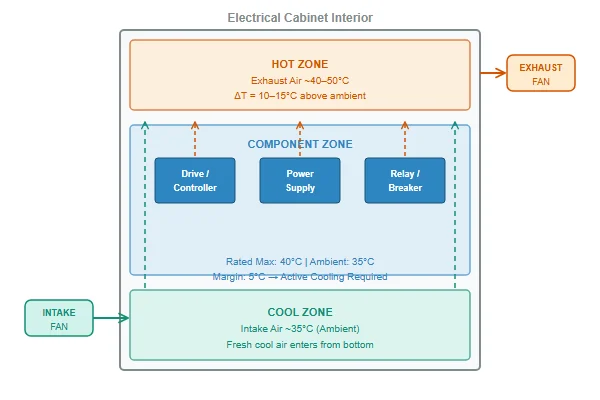
Beyond component heat load, calculate the temperature rise you can tolerate. If components are rated for 40°C maximum and your ambient temperature hits 35°C, you have only 5°C of margin — which means you need enough airflow to keep the internal cabinet temperature within 5°C of ambient. Most cabinet cooling designs target 10-15°C rise above ambient as a practical working margin.
Where Should Intake and Exhaust Fans Be Positioned?
Fan placement determines whether your airflow actually reaches the components that need cooling, or just moves air around the empty spaces in the cabinet. The fundamental rule is that air follows the path of least resistance — if there's an easier route than flowing past your heat-generating components, that's where it will go. Getting this right also depends on choosing the correct fan-out vs. fan-in airflow orientation for each opening, which is easy to get backwards in a rush installation.
Intake fan positioning:
- Mount intake fans low on the cabinet, since you want cool ambient air entering at the bottom
- Position intakes to direct airflow across the hottest components first, before the air picks up heat from other sources
- Avoid placing intakes directly opposite exhaust fans, which creates a "short circuit" where air flows directly from intake to exhaust without cooling anything in between
Exhaust fan positioning:
- Mount exhaust fans high on the cabinet to take advantage of natural thermal rise — hot air wants to rise anyway
- Size exhaust slightly smaller than intake capacity if you want positive pressure (helps control dust entry points)
- Size exhaust slightly larger than intake capacity if you want negative pressure (pulls ambient air through any unsealed gaps)
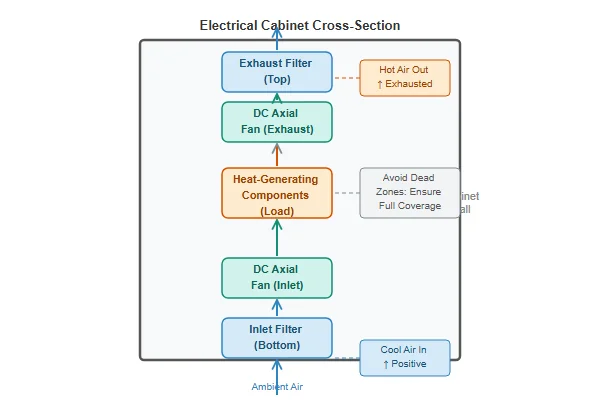
The most reliable approach for larger cabinets is a bottom-to-top airflow pattern: filtered intake fans at the bottom, exhaust fans at the top, with internal air dams or baffles that force the airflow to pass by heat-generating components rather than taking shortcuts through empty space.
With more than 20 years of production and R&D experience, Herays manufactures DC axial fans as an OEM partner for several well-known brands, under a quality system certified to ISO 9001, ISO 14001, QC 080000, and IATF 16949. For cabinet cooling applications specifically, we maintain in-house CFM airflow testing systems and temperature cycling test chambers that validate fan performance under the thermal stress cycles common in industrial environments — since cabinet fans experience wider temperature swings than most other DC fan applications.
What Fan Size and CFM Do You Actually Need?
Fan sizing for cabinets involves balancing CFM capacity against static pressure capability, since cabinet fans always work against some level of restriction from filters, grilles, and internal airflow obstacles.
The traditional sizing formula calculates required CFM based on heat load and allowable temperature rise:
CFM = (Heat load in watts × 3.16) / (Temperature rise in °C)
This formula gives you the theoretical airflow needed, but real-world cabinet installations need 50-100% more CFM capacity to account for:
- Filter restriction that increases over time as dust accumulates
- Internal pressure losses from cable management, component mounting, and airflow direction changes
- Reduction in fan performance as temperature rises (most fan curves are rated at 25°C ambient)
| Cabinet size | Typical fan size | CFM range | Common applications |
|---|---|---|---|
| Small control panels (< 24" height) | 80mm - 120mm | 30-80 CFM | PLC cabinets, small drive panels |
| Medium cabinets (24"-48" height) | 120mm - 172mm | 80-200 CFM | Multi-drive systems, process control |
| Large cabinets/enclosures (> 48" height) | 172mm - 225mm | 200-400+ CFM | Motor control centers, large automation systems |
Static pressure becomes the limiting factor once you add filtration. A fan rated for 150 CFM in free air might deliver only 75 CFM when working against a dirty filter, regardless of what the CFM rating suggests. This is why cabinet cooling designs should specify fans based on their performance at 0.2" to 0.4" H2O static pressure, not their free-air CFM rating. If you want to confirm actual delivered airflow rather than trust the datasheet number, I'd point you to how to measure airflow (CFM) in a real system — it's a step I recommend for any cabinet design before it goes into production.
Cabinet enclosures themselves are also rated for environmental protection, and the cooling method you choose has to be compatible with that rating. Enclosures rated against dust and water ingress under IEC or NEMA classifications restrict which cooling approaches are usable 1 — a sealed NEMA 4X enclosure, for instance, generally can't use a simple open intake/exhaust fan pair the way a ventilated NEMA 1 panel can.
How Do You Handle Filters and Dust Management?
Dust management in cabinet cooling requires balancing filtration effectiveness against airflow restriction. Over-filtering can create enough pressure drop to stall your fans; under-filtering lets dust accumulate on components and heat sinks, reducing cooling effectiveness over time.
Filter selection guidelines:
- MERV 8-11 filters handle most industrial dust without excessive restriction
- MERV 13-16 filters are needed for very fine particles but require larger fan capacity to overcome pressure drop
- Washable/reusable filters reduce maintenance costs in high-dust environments
- Pre-filters plus final filters work better than single-stage filtration for heavy dust loads
Practical dust management strategies:
- Use positive pressure (slightly more intake than exhaust) to control where dust enters the cabinet
- Install filter monitoring switches or pressure sensors to alert when cleaning is needed
- Design filter access panels that allow replacement without shutting down the cabinet
- Consider fan-and-filter units with integrated housings for easier maintenance
The biggest mistake I see in cabinet dust management is treating it as purely a filtration problem. Even perfect filters fail if the airflow design creates dead zones where dust settles, or if filter maintenance gets deferred until restriction becomes severe enough to cause overheating.
FAQ
What's the difference between AC and DC fans for cabinet cooling? DC fans offer better speed control, lower power consumption, and easier integration with cabinet control systems, but AC fans are simpler to wire and don't require DC power supplies. DC fans typically provide better low-speed performance when variable cooling is needed.
Should cabinet fans run continuously or only when temperatures rise? Continuous operation prevents thermal cycling stress on components and maintains consistent airflow patterns, but temperature-controlled operation saves energy and extends fan life. Most industrial applications favor continuous operation for reliability, with speed modulation based on temperature.
How often should cabinet filters be replaced? Filter replacement intervals depend on dust loading and filter type, typically ranging from monthly in high-dust environments to quarterly in clean facilities. Pressure differential monitoring provides more accurate replacement timing than fixed schedules.
Can I use multiple smaller fans instead of one large fan? Multiple smaller fans provide redundancy and can improve airflow distribution, but increase complexity and potential failure points. One larger fan typically moves more air per watt and generates less noise than multiple smaller fans with equivalent total CFM.
What happens if intake and exhaust CFM don't match exactly? Slight mismatches are normal and often intentional. More intake than exhaust creates positive pressure (good for dust control), while more exhaust than intake creates negative pressure (pulls cool air through unsealed gaps). Large mismatches can cause airflow problems or unnecessary energy consumption.
"IEC (IP) and NEMA Rated Enclosures", https://tripplite.eaton.com/products/enclosure-ratings. An Eaton/Tripp Lite reference explaining how IEC IP ratings and NEMA enclosure types classify protection against dust and water ingress, and how those classifications relate to allowable cooling methods. ↩

Liang
I've been working with DC fans for 30 years — long enough to have seen the industry evolve from basic sleeve bearing designs to today's high-efficiency, IP68-rated systems built for the harshest environments imaginable. I founded Herays because I believed manufacturers and engineers deserved a supplier who could talk technical from day one. Not just hand over a datasheet, but actually help you select the right fan for your thermal load, your enclosure, your certification requirements. Most of what I write here comes directly from problems I've solved on the factory floor or in customer applications — medical devices, laser equipment, industrial automation, you name it. If it involves moving air efficiently and reliably, I've probably spent time thinking about it. When I'm not obsessing over airflow curves, I'm usually helping a customer figure out why their cooling system isn't performing the way their simulation said it would.
View all posts by Liang