Connect a standard 12V computer fan straight to a solar panel and it'll either refuse to start in low light or cook itself at midday -- solar power just isn't the stable voltage source most fans are designed for.
- Solar isn't a stable voltage source. A fan built for these systems has to handle wide swings from dawn to dusk without stalling or burning out.
- A "12V" solar panel can hit 18V or more in full sun, open-circuit -- enough to damage a standard 12V fan that was never built for that headroom.
- Wide-input-voltage fans solve this with internal regulators that safely span a broad range, say 7V to 24V, which is what makes them suitable for a direct solar connection.
- Power draw matters more here than almost anywhere else. Every watt the fan pulls is a watt not available for battery reserves overnight or through a cloudy stretch.
- For outdoor solar setups like greenhouses or RVs, IP rating and bearing type end up mattering just as much as the airflow spec for long-term reliability.
I’ve been working with DC fans for 30 years, long enough to see them move from simple electronics cooling into all sorts of challenging environments. One of the toughest, and where I see the most failures, is in solar-powered systems. Too often, people assume any DC fan will work. They connect a standard 12V computer fan to a solar panel, and it either fails to start in low light or burns out in the midday sun.
The problem isn't the fan; it's the application. Solar power is a wild, fluctuating beast, not the clean, stable power from a wall adapter. Choosing the right fan isn't just about moving air—it's about surviving the power source.
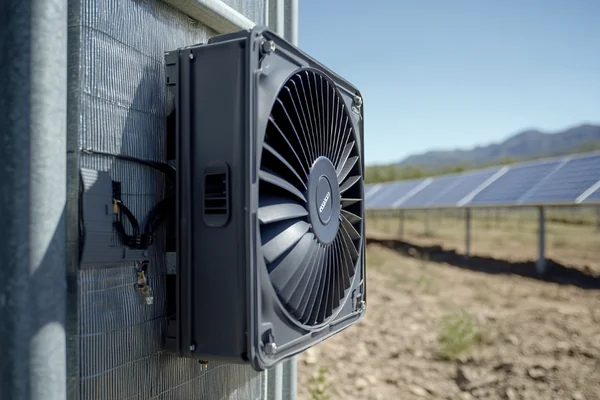
Table of Contents
Why Do Solar-Powered Systems Need Specialized Fans?
When I get a call about a fan for a solar project, my first questions are always about the environment and the power source. Unlike a fan inside a desktop PC, a fan in a solar application is often fighting a battle on two fronts.
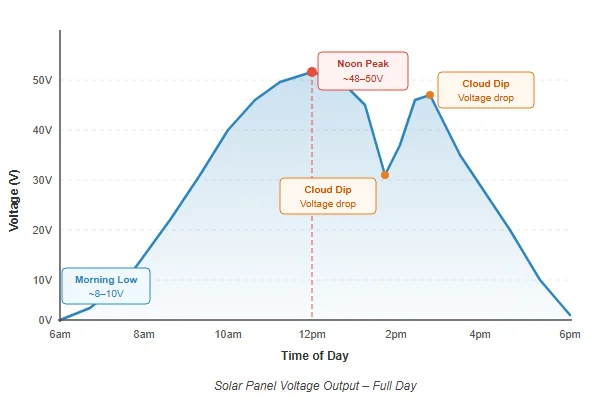
First, the power is unpredictable. The voltage from a solar panel swings dramatically with the intensity of the sun. It’s low at dawn, peaks at noon, and drops with every passing cloud. A standard DC fan is designed for a stable voltage with a relatively tight tolerance, usually in the ±10-15% range depending on the manufacturer's specifications. It simply isn't built for that kind of volatility.
Second, the environment is often harsh. Whether it's for a greenhouse, an RV roof vent, or an off-grid equipment cabinet, the fan is exposed to heat, humidity, dust, and sometimes rain. This is where specifications like a waterproof DC fan's IP rating and the right bearing choice become critical for survival. A fan with an open-frame sleeve bearing might last for years in an office, but it can seize up after one season of humid, dusty operation in a barn.
What Are the Voltage Challenges in Solar-Powered Setups?
This is the number one technical hurdle I help engineers overcome. The term "12V solar panel" is a nominal classification; it doesn't describe the actual output voltage. The fan's motor controller sees the raw voltage, and that voltage is all over the map.
- Under-voltage: In the early morning, late evening, or on heavily overcast days, the panel's voltage might be too low to start a standard fan. The fan's internal controller needs a minimum voltage to energize the motor coils. If the input is below this threshold, the fan just sits there, twitching or doing nothing at all.
- Over-voltage: This is the more destructive problem. In bright, direct sunlight, that "12V" panel can easily output 18V or more. When a standard 12V fan receives this voltage, its motor controller tries to spin the fan far faster than it was designed for. This causes excessive current draw, overheating of the motor windings and electronics, and can quickly lead to a burned-out fan.
The choice of system voltage, whether it's a 12V, 24V, or 48V DC fan system, must match your battery and charge controller, not just the panel's nominal rating. If you're running the fan directly from a panel without a battery, the voltage swings are even more extreme.
How Do Wide Input Voltage Range Fans Help?
The solution I almost always recommend for direct-solar or other unstable DC sources is a fan with a wide input voltage range. These aren't standard fans; they have a more sophisticated motor driver circuit inside that acts like a built-in voltage regulator (specifically, a buck-boost converter).
This specialized circuit takes the chaotic input voltage from the panel and converts it to the stable internal voltage the motor needs. This allows the fan to:
- Start at a much lower voltage, enabling it to run in lower light conditions.
- Survive high voltage spikes, protecting the motor from burnout in full sun.
- Maintain a more consistent speed across a wider range of input voltages, providing more predictable airflow.
Here’s a practical comparison from what I've seen on the factory test bench:
| Feature | Standard 12V Fan | Wide-Range 12V Fan | Why It Matters for Solar |
|---|---|---|---|
| Operating Voltage | 10.8V – 13.2V (typical) | 7V – 24V (example) | Starts earlier, runs later, and doesn't burn out at midday. |
| Behavior at 8V | Fails to start or stalls. | Runs at a reduced, stable speed. | Provides ventilation even in suboptimal light. |
| Behavior at 18V | Over-speeds, overheats, and burns out quickly. | Runs at its rated speed, protected by internal regulator. | Ensures long-term reliability without a separate regulator. |
For any serious solar-powered ventilation project, specifying a wide-range input fan is the first and most important step.
I founded Herays with the belief that engineers deserved a supplier who understood the application, not just the part number. For over 20 years, we've been the OEM partner for brands who need that level of detail. Our quality system is certified to ISO 9001 and IATF 16949, but for applications like solar, it's our in-house testing that makes the difference. We can validate fan performance in our temperature cycling chambers to simulate day/night heat changes and use our salt spray test system to prove a fan's corrosion resistance for marine or agricultural environments. This isn't about just meeting a spec; it's about proving the fan will survive in the real world.
Why is Low Power Consumption Critical for Solar Applications?
Once the voltage issue is solved, the next critical factor is efficiency. In a solar-powered system, especially one with a battery, every watt of power is precious. A fan is a continuous load; its power draw directly impacts how long your battery system can last.
The goal is to achieve the required airflow (CFM) using the least amount of power (watts). This is the definition of DC axial fan efficiency, and it comes down to a few key design elements:
- Motor Design: Modern brushless DC (BLDC) motors are inherently more efficient than older motor types. The design of the stator and the quality of the magnets play a huge role.
- Blade and Hub Aerodynamics: A well-designed blade moves more air with less turbulence. On the factory floor, I can see the difference immediately in our airflow test chamber—a good blade design is quieter and draws less current for the same CFM.
- Bearing Type: A low-friction bearing, like a quality ball bearing, reduces the mechanical drag on the motor, saving a small but constant amount of energy.
I've worked on projects where switching from an inefficient, generic fan to a high-efficiency model with the same airflow rating effectively doubled the system's ventilation runtime on battery power. That's the difference between having air circulation through the night and having the fan die a few hours after sunset.
What Are Some Real-World Solar Fan Applications?
The principles are the same, but the specific fan choice varies by application. Here are a few common scenarios I’ve helped engineer solutions for:
- Greenhouse Ventilation: The main goals are high airflow to exhaust heat and moisture, and weather resistance. Large 120mm or 172mm DC fans with high IP ratings (IP55 or higher) and ball bearings are a good fit here. They need to run all day in a hot, humid environment.
- RV and Camper Van Ventilation: Here, noise and power draw are the top concerns. A fan for a roof vent or refrigerator cooling coil needs to be quiet enough to sleep near and efficient enough to run for days off-grid. Often, a 120mm or 140mm fan optimized for low-RPM, low-noise operation is the best choice.
- Off-Grid Enclosure Cooling: This is critical for protecting batteries and inverters. Electronics like solar charge controllers are designed to reduce their power output when they get too hot, a behavior documented in manufacturer manuals like Victron Energy's MPPT controller guides1. A small, reliable fan (like a 40mm or 60mm model) ensures the system delivers full power by keeping the controller cool. Reliability is everything, as a failure could compromise the entire power system.
In all these cases, the fan isn't just an accessory; it's an essential component that enables the rest of the system to function as designed.
FAQ
Can I connect a standard DC fan directly to a solar panel? I strongly advise against it. A standard fan is not designed to handle the wide voltage fluctuations from a solar panel, especially the high voltage in direct sun, which can quickly burn it out. You should use a fan specifically designed with a wide input voltage range.
What's more important for a solar fan: airflow (CFM) or low power (watts)? It's a balance, but low power consumption is uniquely critical for solar. You need enough CFM to do the job, but beyond that, prioritizing efficiency (low wattage) will maximize your system's runtime on battery power, which is crucial for overnight or cloudy day operation.
What IP rating should I look for in an outdoor solar fan? For a location that might get rain or spray, look for a rating of at least IP55. If the fan will be exposed to heavy jets of water or temporary submersion, you'll need IP67 or IP68. For dusty environments like a barn or workshop, a rating of IP5X provides good dust protection.
Will a solar-powered fan run at night? Only if it's connected to a system with a battery and a charge controller. A fan connected directly to a solar panel will only run when the sun is providing enough power. For overnight operation, the fan must draw power from a battery charged during the day.
Do I need a 12V, 24V, or 48V fan for my solar system? The fan's voltage should match your system's battery bank voltage. If you have a 12V battery system, use a 12V fan. If you have a 24V battery bank, use a 24V fan. This ensures the fan operates within its intended voltage range when powered by the battery.
"SmartSolar/BlueSolar MPPT Manual", https://www.victronenergy.com/upload/documents/Manual_SmartSolar_MPPT_100-30__100-50/29694-MPPT_solar_charger_manual-pdf-en.pdf. The official manual for Victron's solar charge controllers states that the device will protect itself against overheating by reducing output current if the temperature becomes too high, underscoring the need for proper ventilation in solar equipment enclosures. ↩

Liang
I've been working with DC fans for 30 years — long enough to have seen the industry evolve from basic sleeve bearing designs to today's high-efficiency, IP68-rated systems built for the harshest environments imaginable. I founded Herays because I believed manufacturers and engineers deserved a supplier who could talk technical from day one. Not just hand over a datasheet, but actually help you select the right fan for your thermal load, your enclosure, your certification requirements. Most of what I write here comes directly from problems I've solved on the factory floor or in customer applications — medical devices, laser equipment, industrial automation, you name it. If it involves moving air efficiently and reliably, I've probably spent time thinking about it. When I'm not obsessing over airflow curves, I'm usually helping a customer figure out why their cooling system isn't performing the way their simulation said it would.
View all posts by Liang