A greenhouse is built to trap heat and humidity -- which is great for the plants and terrible for anything electronic inside it, fans included.
- Greenhouse ventilation isn't only about cooling. It's what manages humidity, keeps fungal disease down, and replenishes the CO2 plants need to grow.
- A good starting point for airflow is one full air exchange per minute, or roughly 1-3 CFM per square foot of floor space.
- DC axial fans fit solar-powered ventilation especially well, since they run efficiently on low-voltage DC and don't need grid power to operate.
- In a humid greenhouse, IP rating matters more than raw CFM. I look for IP55 or higher before anything else, for the sake of long-term reliability against moisture and dust.
- Placement matters as much as power. Exhaust fans belong high on one wall with low intakes on the opposite side; circulation fans should just keep a gentle, circular airflow moving through the space.
I’ve spent three decades working with DC fans, from tiny units in medical devices to large ones for industrial cooling. But some of the most interesting challenges I've seen come from applications where the environment itself is the biggest factor. A greenhouse is a perfect example. It's a closed system designed to trap heat and humidity — the very things that can destroy both the plants inside and the electronics meant to protect them.
I've talked to many growers who initially installed a standard box fan, only to see it rust and fail within a single season. A greenhouse isn't a room; it's a high-humidity, high-temperature, and often dusty environment. Choosing the right fan isn't just a matter of moving air; it's about selecting a tool that can survive the job.
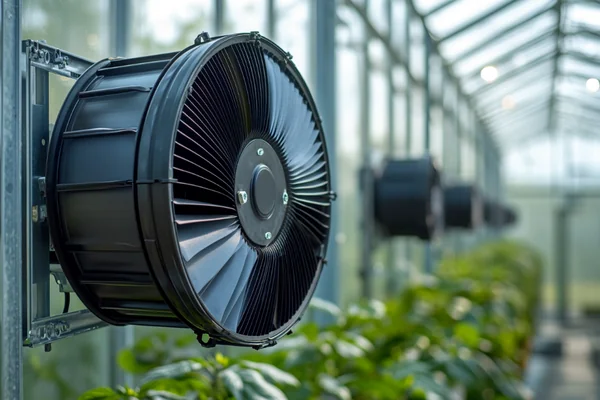
Table of Contents
Why Does a Greenhouse Need Active Ventilation?
A sealed greenhouse is a heat trap by design. Without active ventilation, the environment quickly becomes hostile to most plants. From an engineering perspective, I see three primary problems that proper airflow solves:
- Temperature Control: On a sunny day, the internal temperature can soar far above the ambient outdoor temperature, stressing or killing plants. Ventilation exhausts this super-heated air and draws in cooler, fresh air.
- Humidity Management: Plants transpire, releasing water vapor. In a sealed space, this raises humidity to levels where fungal diseases like botrytis and powdery mildew thrive. Air circulation dries moisture from leaf surfaces and exhausts damp air.
- Gas Exchange: Plants consume Carbon Dioxide (CO2) during photosynthesis. In a sealed greenhouse, CO2 levels can become depleted, stalling growth. Ventilation constantly replenishes the CO2 supply from the outside air.
Forgetting any one of these three functions is a common mistake I see. A setup that only cools but doesn't manage humidity might save plants from heatstroke but leave them vulnerable to disease.
How Do I Calculate the Right Airflow for My Greenhouse?
The goal of a ventilation system is to perform a complete air exchange at a specific rate. The industry benchmark, outlined in standards like ANSI/ASAE EP406.4, is to achieve at least one air exchange per minute1.
For a quick calculation, here's the formula I give to customers as a starting point:
Greenhouse Volume (Cubic Feet) = Length x Width x Average Height
Your target airflow in Cubic Feet per Minute (CFM) should be at least equal to the greenhouse volume. For example, a 10' x 20' greenhouse with an average height of 8' has a volume of 1,600 cubic feet. Therefore, you'd need fans capable of moving at least 1,600 CFM to achieve one air exchange per minute.
A simpler rule of thumb for hobbyist setups is to provide 1-3 CFM per square foot of floor space. For that same 10' x 20' (200 sq ft) greenhouse, this would suggest a fan system between 200 and 600 CFM. I recommend starting at the lower end and observing, as you can always add more airflow. You can learn more about how to measure airflow to verify your setup.
Can I Use Solar-Powered Fans for My Greenhouse?
Absolutely. This is one of the best applications for DC axial fans. Because they run on direct current, they can be powered directly by solar panels, often with just a simple charge controller in between. This is something I've helped engineers design for remote agricultural and monitoring stations.
The key benefits are:
- Off-Grid Operation: Perfect for greenhouses located far from a mains power source.
- Energy Savings: No ongoing electricity cost.
- Automatic Scaling: The fan naturally runs fastest during the sunniest, hottest part of the day, which is exactly when the most ventilation is needed.
When selecting a fan for a solar setup, voltage matching is key. Most solar systems for this scale are built around 12V or 24V. You'll want to choose a fan that matches your system's nominal voltage. You can read more about selecting between 12V, 24V, and 48V fans. A brushless DC motor is highly efficient, converting more of that precious solar energy into airflow instead of wasted heat.
I started Herays to solve real-world engineering problems, and a greenhouse is a tough environment. It's hot, humid, and dusty. That's why having the right testing equipment is non-negotiable. For applications like this, we rely on our in-house temperature cycling and salt spray test systems to validate that our fans can withstand harsh conditions over the long term. Many factories can produce a fan that meets a CFM spec on day one, but for a greenhouse, what matters is how it performs after a thousand hours of humidity and temperature swings. Our ISO 9001 and IATF 16949 quality systems ensure that the fan you test is the same one you get in production.
How Do Fans Help Control Greenhouse Humidity and Temperature?
It's helpful to think of greenhouse ventilation in two distinct parts: air exchange and air circulation. You need different fan strategies for each. I've put together a simple table to explain the difference.
| Fan Type | Primary Function | How it Controls Environment |
|---|---|---|
| Exhaust Fans | Temperature & Humidity Reduction | Mounted in the wall, these fans actively pull hot, moist air out of the greenhouse and draw in fresh, cooler, drier air through an intake vent. |
| Circulation Fans (HAF) | Air Mixing & Uniformity | Mounted inside the greenhouse, these fans gently move air to prevent hot/cold spots, eliminate stagnant air pockets, and dry moisture on plant leaves. |
The most effective systems I've seen use both. Exhaust fans handle the heavy lifting of air exchange, while smaller Horizontal Airflow (HAF) fans ensure the fresh air is distributed evenly. For any fan used in a greenhouse, I strongly recommend a model with an IP55 rating or higher. This ensures the motor and electronics are protected from dust and water spray. You can find more detail in my guide to waterproof IP ratings.
Where Should I Place Fans for the Best Air Circulation?
Poor placement can make even the most powerful fan ineffective. Based on what I've seen work on the factory floor and in customer installations, here is the standard approach:
- Exhaust Fan(s): Install the exhaust fan high up on the wall, as hot air naturally rises. Place it at the end of the greenhouse opposite your main door or intake vent to create a clear cross-breeze path.
- Intake Vent(s): The intake vent should be on the opposite wall from the exhaust fan, and positioned lower down. The total area of the intake should be equal to or slightly larger than the exhaust opening to avoid starving the fan.
- Circulation (HAF) Fans: These should be placed above the plants and aimed horizontally along the length of the greenhouse. The goal is to create a large, slow-moving, circular pattern of air, almost like a "racetrack." This ensures no corner becomes stagnant. For a long greenhouse, you would use multiple fans in series, all pushing the air in the same circular direction.
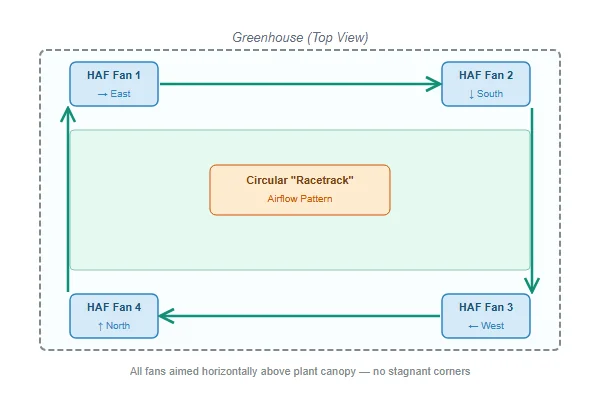
Getting this flow pattern right is key. It gently strengthens plant stems, prevents moisture from settling, and ensures every plant gets access to fresh air and CO2.
FAQ
What's the difference between an exhaust fan and a circulation fan? Exhaust fans are powerful fans mounted in the wall to exchange inside air with outside air, primarily for temperature and humidity control. Circulation fans (or HAF fans) are smaller fans placed inside the greenhouse to gently move air around, preventing stagnant spots and ensuring uniform conditions.
What IP rating do I need for a greenhouse fan? I recommend a minimum of IP55. The first '5' means it's protected from enough dust to not interfere with operation, and the second '5' means it's protected against water jets from any direction. This is crucial for handling high humidity, condensation, and accidental spraying from watering.
How many air changes per minute does a greenhouse need? The standard recommendation is a minimum of one complete air exchange per minute to prevent excessive heat and humidity buildup. In very hot climates or for sensitive crops, you might aim for 1.5 to 2 air changes per minute.
Should my intake be bigger or smaller than my exhaust fan area? Your air intake opening should be equal to or slightly larger than the area of your exhaust fan opening. If the intake is too small, you create high negative pressure, which forces the fan to work much harder and reduces its efficiency, a concept related to static pressure versus CFM.
Can I run a DC fan directly from a solar panel? While possible, it's not ideal. I recommend using a charge controller and a small battery between the panel and the fan. This provides a stable voltage to the fan motor, protecting it from fluctuations, and allows the fan to run for a short period even if a cloud passes over.
"ANSI/ASAE EP406.4 JAN03 — Heating, Ventilating and Cooling Greenhouses", https://ceac.arizona.edu/sites/default/files/asae_-_heating_ventilating_and_cooling_greenhouses.pdf. The standard from the American Society of Agricultural Engineers outlines the engineering principles and data for designing greenhouse environmental control systems, including recommended ventilation rates. ↩

Liang
I've been working with DC fans for 30 years — long enough to have seen the industry evolve from basic sleeve bearing designs to today's high-efficiency, IP68-rated systems built for the harshest environments imaginable. I founded Herays because I believed manufacturers and engineers deserved a supplier who could talk technical from day one. Not just hand over a datasheet, but actually help you select the right fan for your thermal load, your enclosure, your certification requirements. Most of what I write here comes directly from problems I've solved on the factory floor or in customer applications — medical devices, laser equipment, industrial automation, you name it. If it involves moving air efficiently and reliably, I've probably spent time thinking about it. When I'm not obsessing over airflow curves, I'm usually helping a customer figure out why their cooling system isn't performing the way their simulation said it would.
View all posts by Liang