Blade count is one of the most misunderstood specs on a DC axial fan datasheet -- more blades doesn't automatically mean better performance, and picking the wrong count can leave you with a fan that looks great on paper and underperforms in the real enclosure.
- Blade count runs anywhere from 3 to 13 on DC axial fans, and each configuration trades off airflow, static pressure, and noise differently.
- Fewer blades (3-5) push higher max CFM but lower static pressure -- a good fit for open-air cooling where there's little resistance.
- More blades (7-13) trade some peak airflow for higher static pressure and quieter running, which is what you want behind filters, grilles, or restricted paths.
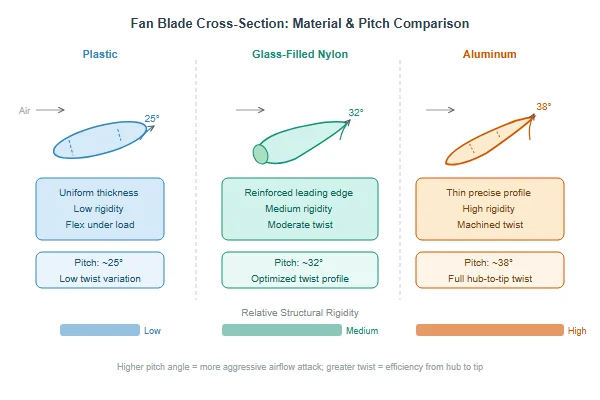
- Blade material and pitch angle matter more than the raw count. Aluminum and glass-filled nylon blades hold their shape under stress far better than basic plastic ones.
- The right blade count comes down to your system's pressure requirements, not the CFM number you'd like to hit -- real-world performance and free-air specs are two different things.
When I work with customers selecting DC axial fans, blade count is one of the most misunderstood specifications. Engineers often assume more blades automatically mean better performance, or that blade count is just a manufacturing detail that doesn't affect real-world cooling. The reality is more nuanced — blade count directly influences the pressure-airflow characteristics of a fan, and choosing the wrong configuration can leave you with a fan that looks good on paper but underperforms once installed. If you haven't already, it's worth reading my overview of how a DC axial fan works and what its key specs mean before getting into blade-level details.
Table of Contents
How Does Blade Count Affect Airflow?
Blade count determines how a fan divides the available motor torque between moving large volumes of air versus building pressure against resistance. Each blade acts as a small airfoil, and adding more blades changes the aerodynamic behavior of the entire rotor assembly.
3-5 blades create larger gaps between each blade, allowing air to flow with less turbulence but also less pressure buildup. The result is higher peak airflow in free-air conditions, but performance drops quickly when the fan encounters any restriction like a filter or heat sink.
7-9 blades represent the middle ground I most often recommend for general-purpose cooling. This range balances reasonable airflow with enough static pressure to work through moderate restrictions like perforated panels or loose-weave filters.
11-13 blades pack more airfoil surfaces into the same rotor diameter, creating higher pressure but with diminishing returns on peak airflow. These configurations excel when the fan must push air through dense heat sinks, tight ductwork, or multiple layers of filtration.
A peer-reviewed CFD study of axial fan rotors confirms this isn't just a rule of thumb — simulations show that both blade geometry and blade count directly reshape the fan's pressure distribution and stall behavior 1, which is exactly why two fans with the same frame size and motor can perform very differently once blade count changes.
Why Do Fewer Blades Mean High CFM but Low Pressure?
From an aerodynamic perspective, fewer blades allow each individual blade to move through less disturbed air. With larger gaps between blades, there's less interaction between the airflow coming off one blade and the leading edge of the next blade. This reduces turbulence and allows the fan to move larger volumes of air efficiently — but only when there's minimal resistance downstream.
The trade-off becomes apparent when you mount the fan against any restriction. Fewer blades generate less pressure rise across the fan, so when the system creates back-pressure, the fan can't maintain its rated airflow. I see this most often when customers test a fan in free air, get excellent CFM numbers, then see performance drop dramatically once the fan is installed behind a filter or grille. If you want to confirm this yourself rather than trust the datasheet, I've covered how to measure airflow (CFM) in a real fan system in a separate guide.
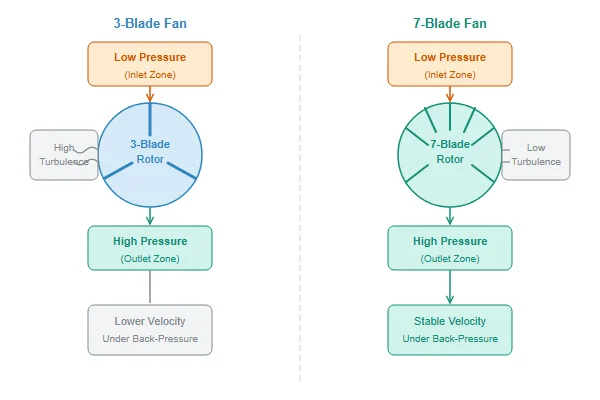
This is why comparing free-air CFM ratings between fans with different blade counts can be misleading. A 5-blade fan might show higher CFM than a 9-blade fan on the datasheet, but the 9-blade fan will likely outperform it in any real installation where the air has to travel through ducts, around components, or past obstacles.
Why Do More Blades Create Quieter Operation and Higher Static Pressure?
Adding more blades spreads the work of moving air across more surfaces, which allows each individual blade to operate at a lower angle of attack. This reduces the noise signature because each blade is working less aggressively, even though the overall fan is moving the same amount of air.
More blades also create more pressure pulses per revolution. While this might sound like it would increase noise, the opposite happens — more frequent, smaller pressure pulses blend together into a smoother, less noticeable sound compared to the distinct "whooshing" of a 3-blade fan.
| Blade count | Typical noise characteristic | Best use case |
|---|---|---|
| 3-5 blades | Higher amplitude, lower frequency | High-airflow, open-air applications where noise isn't critical |
| 7-9 blades | Balanced noise and performance | General-purpose cooling with moderate restrictions |
| 11+ blades | Lower amplitude, higher frequency | Quiet operation with high static pressure requirements |
The static pressure advantage comes from having more surfaces actively pushing against the air resistance. Each blade contributes to building up pressure, so more blades create more cumulative pressure rise across the fan — exactly what you need when the air has to squeeze through a dense heat sink or travel through a long duct run.
With more than 20 years of production and R&D experience, Herays manufactures DC axial fans as an OEM partner for several well-known brands. Our in-house anechoic noise test chamber allows us to measure how blade count affects actual noise signatures, not just dBA levels. We've found that blade count interacts with motor speed and frame design in ways that aren't captured by simple "more blades = quieter" rules — which is why we run acoustic testing on each blade configuration during the OEM/ODM development process, alongside CFM testing and dynamic balance correction to ensure consistent performance across production batches.
How Do Blade Material and Shape Affect Performance?
Blade count is only part of the story — the material and shape of those blades determine whether the fan can actually deliver its designed performance under real operating conditions.
Basic plastic blades (typically ABS or basic polypropylene) work fine for low-speed, low-pressure applications, but they can flex under load, especially on higher blade-count fans where each blade is thinner. When blades flex, they lose their designed pitch angle, reducing both airflow and pressure generation.
Glass-filled nylon or composite blades maintain their shape better under stress and temperature cycling. This is particularly important for fans with 9+ blades, where the individual blades are thinner and more prone to deformation.
Aluminum blades are less common but offer the best combination of strength and aerodynamic precision. I typically see these on industrial or high-performance applications where the blade count and pitch need to remain consistent over thousands of hours of operation.
Blade pitch and twist also matter more than the raw blade count. A well-designed 7-blade fan with optimized pitch can outperform a poorly designed 11-blade fan with generic blade geometry. The pitch determines how aggressively each blade attacks the air, while twist along the blade length helps maintain efficient airflow from hub to tip.
What Blade Count Should You Choose?
The right blade count depends on your system's pressure requirements more than the desired CFM rating. Here's how I recommend approaching the decision:
Start with your restriction level:
- Minimal restriction (open chassis, large vents): 3-5 blades for maximum airflow
- Moderate restriction (perforated panels, loose filters): 7-9 blades for balanced performance
- High restriction (dense heat sinks, tight ducts, multiple filters): 11+ blades for static pressure
Consider your noise requirements:
- If noise is critical, lean toward higher blade counts even if you don't need maximum static pressure
- If maximum cooling is the priority and noise isn't a concern, fewer blades will move more air in open conditions
Factor in your operating environment:
- High-temperature or continuous-duty applications benefit from glass-filled or aluminum blades regardless of count
- Cost-sensitive applications can use basic plastic blades if the operating conditions are mild
The most reliable approach is to request pressure-airflow (P-Q) curves for your candidate fans and compare performance at your system's actual operating point, not just the free-air maximums. If you're also deciding between fan sizes, my DC axial fan sizes guide covering 25mm to 172mm is a useful companion to this one, since frame size and blade count interact.
FAQ
Does a 9-blade fan always outperform a 5-blade fan? Not necessarily. The 9-blade fan will likely have better static pressure and quieter operation, but the 5-blade fan may move more air in open conditions. Performance depends on your specific installation requirements.
Why do some manufacturers use odd numbers of blades? Odd blade counts (3, 5, 7, 9) help reduce harmonic resonances and vibration compared to even numbers. This is particularly important for maintaining balance and reducing noise in smaller fans.
Can I replace a 7-blade fan with an 11-blade fan of the same size? Physically yes, but the performance characteristics will change. The 11-blade fan will likely be quieter and handle restrictions better, but may move less peak airflow. Check that the static pressure rating matches your system needs.
Do more expensive fans always have more blades? Not always. Premium fans may have fewer, higher-quality blades with better materials and aerodynamic design rather than simply adding more basic blades. Quality of design matters more than blade count alone.
How do I know if my system needs high static pressure? If your fan sits behind filters, grilles, or dense heat sinks, or if air has to travel through ducts or around obstacles, you need static pressure capability. Fans with higher blade counts typically perform better in these conditions.
"Effect of Blade Design Parameters on Air Flow through an Axial Fan", https://www.ije.ir/article_73041.html. A peer-reviewed CFD study (Semnan University, published in the International Journal of Engineering) numerically modeling axial fan flow and showing how blade geometry and blade count change the fan's pressure distribution and stall behavior. ↩

Liang
I've been working with DC fans for 30 years — long enough to have seen the industry evolve from basic sleeve bearing designs to today's high-efficiency, IP68-rated systems built for the harshest environments imaginable. I founded Herays because I believed manufacturers and engineers deserved a supplier who could talk technical from day one. Not just hand over a datasheet, but actually help you select the right fan for your thermal load, your enclosure, your certification requirements. Most of what I write here comes directly from problems I've solved on the factory floor or in customer applications — medical devices, laser equipment, industrial automation, you name it. If it involves moving air efficiently and reliably, I've probably spent time thinking about it. When I'm not obsessing over airflow curves, I'm usually helping a customer figure out why their cooling system isn't performing the way their simulation said it would.
View all posts by Liang