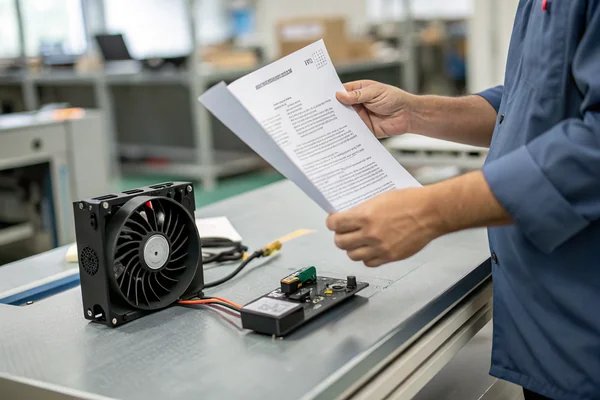
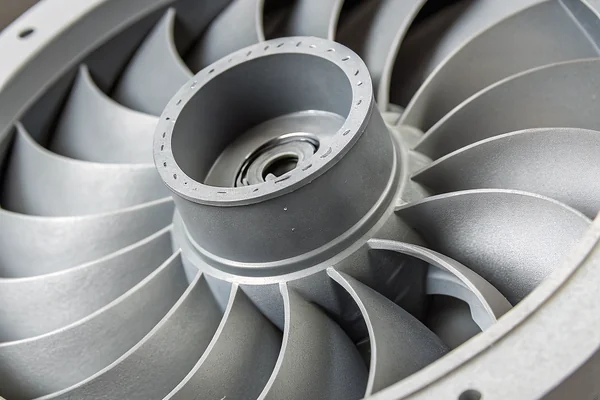
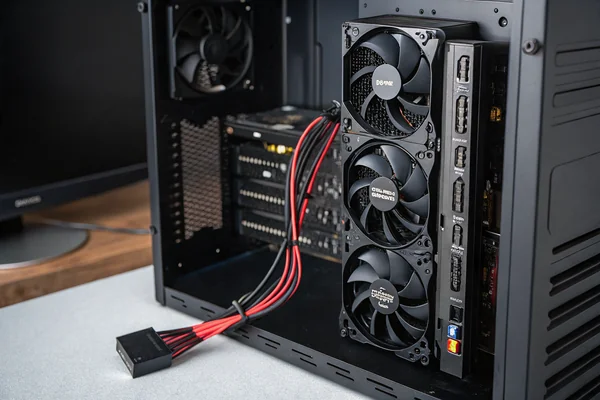
Engineers get stuck comparing CFM ratings and miss the bigger question: does the air in your system move in a straight line, or does it need to turn a corner? That's really what decides between axial and centrifugal.
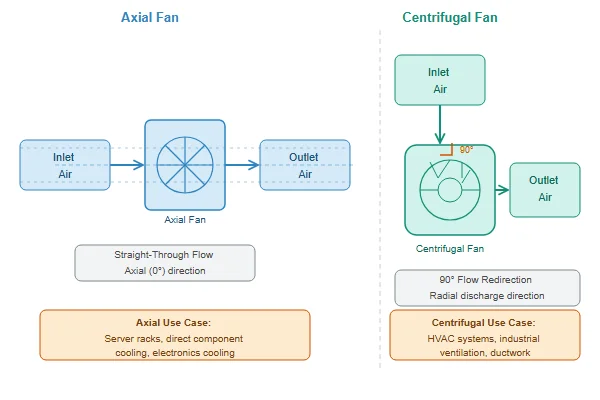
- Axial fans push air straight through along the motor shaft. Centrifugal fans pull air in axially, then redirect it 90 degrees outward.
- Centrifugal fans generate 2-10x more static pressure than a comparable axial fan, which makes them the better choice for pushing air through filters, ducts, and restricted paths.
- Axial fans move more free-air CFM per watt and run quieter at the same airflow -- but their performance falls off fast once they meet real back-pressure.
- For open-air cooling with little obstruction, axial usually wins on efficiency and noise. For ducted or high-resistance systems, centrifugal tends to perform better.
- The right choice depends on your airflow path and pressure requirements, not the CFM number alone -- I've seen plenty of projects pick the wrong fan type by focusing only on volume specs.
When specifying cooling fans, I see engineers get stuck on CFM ratings without considering how the air actually moves through their system. After 30 years in this industry, I've learned that the choice between axial and centrifugal isn't about which technology is "better" — it's about matching the fan's airflow pattern and pressure characteristics to what your enclosure actually needs. Get this wrong, and a fan with impressive datasheet specs can still leave your components running hot. If you're new to fan terminology, it helps to start with what a DC axial fan is and how it works before comparing it against the centrifugal alternative.
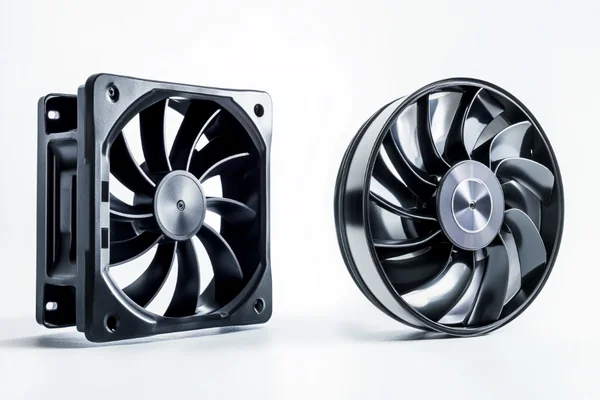
Table of Contents
How Do Axial and Centrifugal Designs Actually Work?
The fundamental difference lies in how each type moves air through the fan housing:
Axial fans use propeller-style blades mounted on a shaft, pulling air in one side and pushing it straight out the other side along the same axis as the motor rotation. Think of a desk fan or computer case fan — air enters from the front, passes through the blades, and exits out the back in the same direction.
Centrifugal fans draw air in parallel to the motor shaft (axially), then use curved impeller blades to accelerate it outward at 90 degrees through a scroll-shaped housing, as described in this overview of centrifugal fan design 1. Air enters through the center intake, gets spun outward by centrifugal force, and exits through a side discharge port.
This design difference affects everything else about how these fans behave once installed. Axial fans work best when they can move air freely in a straight line; centrifugal fans excel when that air needs to change direction, overcome resistance, or build up pressure.
What's Different About Airflow Direction and Pattern?
Understanding airflow direction matters because it determines how you can mount and duct each fan type:
Axial fan airflow:
- Air moves in a straight column parallel to the motor shaft
- Works best with direct, unobstructed paths between intake and exhaust
- Mounting orientation affects performance — works best when air can enter and exit freely
- Airflow pattern is relatively narrow and focused along the fan's centerline
Centrifugal fan airflow:
- Air enters through a central intake port, exits through a side discharge (usually rectangular)
- Can push air through 90-degree bends without major performance loss
- Discharge can be ducted in multiple directions from the fan housing
- Airflow pattern is wider and more uniform across the discharge area
This difference explains why server racks typically use axial fans for direct component cooling, while HVAC systems and industrial ventilation favor centrifugal designs for moving air through ductwork. It's also why getting the fan-out vs fan-in airflow direction right matters just as much as picking axial over centrifugal in the first place — orientation and fan type both shape how air actually moves through your enclosure.
How Do Static Pressure Ratings Compare?
Static pressure — the fan's ability to push air against resistance — is where these two designs show their biggest performance gap:
| Fan type | Typical static pressure range | Best application | Performance under restriction |
|---|---|---|---|
| Axial | 0.1" to 0.8" H2O | Open-air cooling, low-resistance paths | Performance drops quickly as back-pressure increases |
| Centrifugal | 0.5" to 5.0"+ H2O | Ducted systems, filters, high-resistance airflow | Maintains airflow better against back-pressure |
| Backward-curved centrifugal | 1.0" to 8.0"+ H2O | Industrial, high-static applications | Highest static pressure capability |
The reason for this difference goes back to blade design and airflow physics. Axial blades work like airplane propellers — efficient for moving large volumes of air, but they stall when they hit too much resistance. Centrifugal impellers work more like pumps, using rotation and housing shape to build pressure as well as move volume. If you want to verify this for your own application rather than rely on the datasheet curve, I'd point you to how to measure CFM accurately under real system resistance.
In practical terms, this means that if your cooling airflow has to pass through a filter, travel through ducts, or work against any significant back-pressure, the centrifugal fan will likely maintain its rated airflow while an axial fan's performance drops off dramatically.
With more than 20 years of production and R&D experience, Herays manufactures both axial and centrifugal fans as an OEM partner for several well-known brands, under a quality system certified to ISO 9001, ISO 14001, QC 080000, and IATF 16949. When customers ask us to validate performance between axial and centrifugal candidates, our in-house CFM airflow test system and anechoic noise test chamber let us measure actual pressure-airflow curves and dBA levels under real load conditions — not just free-air specs that can be misleading once the fan goes into a restrictive enclosure.
What About Noise and Efficiency Trade-offs?
The noise and power efficiency comparison isn't straightforward, because it depends heavily on operating conditions:
Axial fans typically:
- Run more efficiently (higher CFM per watt) in free-air conditions
- Generate less noise at equivalent free-air flow rates
- Show sharp efficiency and noise penalties when restricted
- Work well for direct cooling where components are close to the fan
Centrifugal fans typically:
- Use more power per CFM in free-air conditions, but maintain efficiency under load
- Can actually run quieter than axial fans when both are pushing against significant static pressure
- Provide more consistent noise levels across their operating range
- Handle variable system resistance better without dramatic noise changes
The key insight is that efficiency and noise should be compared at your actual operating point, not at free-air maximum ratings — the same principle I apply when evaluating overall fan efficiency for a customer's specific system. A centrifugal fan might look less efficient on paper, but if your system has enough resistance that an axial fan has to run at higher speed to maintain airflow, the centrifugal can end up both more efficient and quieter in practice.
How Do You Decide Which Fan Type to Pick?
Here's a quick decision framework based on the projects I've supported over the years:
| Choose axial when: | Choose centrifugal when: | Consider either when: |
|---|---|---|
| You need direct cooling with minimal obstructions | Airflow must pass through filters, grilles, or ducts | Space constraints limit your options to one mounting style |
| Maximum free-air CFM is the priority | Static pressure requirements exceed 0.5" H2O | Noise requirements are strict and you can test both |
| Cost and simplicity matter more than versatility | Airflow direction needs to change (90-degree bends) | You're replacing an existing fan and unsure of system resistance |
| Mounting space allows straight-through airflow | System resistance varies or might increase over time | Both types are available in your required size/voltage |
The biggest mistake I see is choosing based purely on CFM ratings without considering the actual airflow path. A 100 CFM axial fan might deliver only 40-50 CFM once installed behind a filter and grille, while a 70 CFM centrifugal fan maintains 65+ CFM under the same conditions.
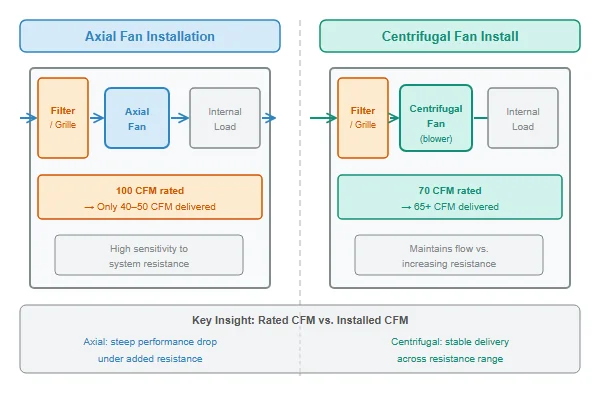
For applications where you're unsure about system resistance or expect it to change over time (like filtration systems that load up with dust), centrifugal fans provide more consistent performance across a wider range of conditions.
FAQ
Can I replace an axial fan with a centrifugal fan of the same CFM rating? Not directly — you need to consider static pressure requirements, mounting orientation, and airflow direction. A centrifugal fan with lower CFM might actually deliver more airflow if your system has significant resistance.
Which type lasts longer in continuous operation? Bearing quality and operating conditions matter more than fan type. However, centrifugal fans often run more consistently because they handle system resistance changes better, which can reduce stress from speed variations.
Are centrifugal fans always more expensive than axial fans? Generally yes, due to more complex housing and impeller manufacturing. However, the price gap narrows at smaller sizes, and centrifugal fans might deliver better value if they eliminate the need for larger axial fans or multiple fans.
How do I measure my system's static pressure requirements? The most reliable method is to measure pressure drop across your actual airflow path using a manometer or differential pressure gauge. Alternatively, test both fan types at your target CFM and compare their performance in your specific installation.
Can centrifugal fans be speed-controlled like axial fans? Yes — both types are available with PWM speed control and tachometer feedback. However, centrifugal fans often maintain better performance characteristics across their speed range, especially in restrictive systems.
"Centrifugal fan", https://en.wikipedia.org/wiki/Centrifugal_fan. Encyclopedia reference defining centrifugal fan operation, including how impeller blades accelerate air radially through a scroll housing to build static pressure. ↩

Liang
I've been working with DC fans for 30 years — long enough to have seen the industry evolve from basic sleeve bearing designs to today's high-efficiency, IP68-rated systems built for the harshest environments imaginable. I founded Herays because I believed manufacturers and engineers deserved a supplier who could talk technical from day one. Not just hand over a datasheet, but actually help you select the right fan for your thermal load, your enclosure, your certification requirements. Most of what I write here comes directly from problems I've solved on the factory floor or in customer applications — medical devices, laser equipment, industrial automation, you name it. If it involves moving air efficiently and reliably, I've probably spent time thinking about it. When I'm not obsessing over airflow curves, I'm usually helping a customer figure out why their cooling system isn't performing the way their simulation said it would.
View all posts by Liang